

- What is Multi-Sensor Data Labeling?
- Why a Dedicated Multi-Sensor Data Labeling Workforce is Needed
- Core Skills Required in a Multi-Sensor Data Labeling Workforce
- Key Use Cases of Multi-Sensor Data Labeling
- Building a Scalable Multi-Sensor Data Labeling Workforce
- Workforce Models for Multi-Sensor Data Labeling
- Role of AI Data Annotation Companies
- Challenges in Managing a Multi-Sensor Data Labeling Workforce
- Future of Multi-Sensor Data Labeling
- Powering the Next Generation of AI
- Frequently Asked Questions
Why Your AI Needs a Multi-Sensor Data Labeling Workforce
Artificial intelligence systems are getting smarter, taking on complex tasks like driving cars, managing city traffic, and operating warehouse robots. To do this safely, these systems rely on a massive amount of data collected from multiple sensors. A single autonomous vehicle might use cameras, radar, and LiDAR simultaneously to understand its surroundings.
However, feeding raw data into an AI model is not enough. The data must be accurately labeled and synchronized. This process ensures the AI understands how different sensor inputs relate to the exact same real-world event. Creating reliable models requires an incredibly high level of precision.
Achieving this precision is rarely possible with general data entry teams. Instead, companies require a specialized multi-sensor data labeling workforce. These trained professionals understand the nuances of 3D spaces, timestamp synchronization, and sensor fusion. Let us explore exactly what this workforce does and why building one is essential for modern AI development.
What is Multi-Sensor Data Labeling?
Multi-sensor data labeling is the process of annotating information collected from several different types of sensors at the same time. This method combines overlapping data points to train AI models, a process often referred to as sensor fusion.
To build context-rich datasets, labeling teams must align data across a variety of common sensor types:
- Cameras: Provide 2D images and video feeds for visual recognition.
- LiDAR: Generate 3D point clouds using light beams to measure distances.
- Radar: Detect the speed and location of moving objects using radio waves.
- GPS and IMU: Track exact geographic positioning and movement orientation.
- Audio sensors: Capture directional sound and acoustic cues.
- Thermal sensors: Detect heat signatures, which is especially useful at night.
Annotators must ensure that an object identified on a camera feed perfectly aligns with the corresponding LiDAR point cloud and radar reflection. This alignment gives the AI a complete, 360-degree understanding of its environment.
Why a Dedicated Multi-Sensor Data Labeling Workforce is Needed
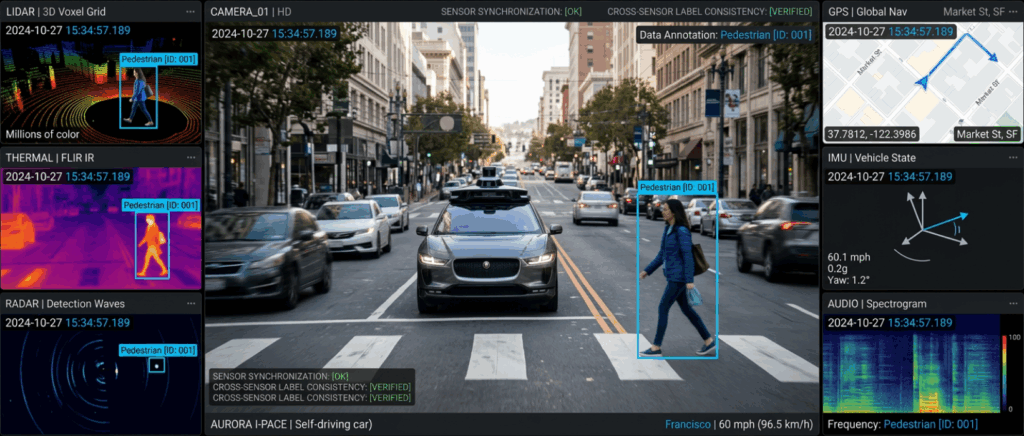
Labeling a standard 2D image is relatively straightforward. Labeling a multi-sensor dataset is highly complex. A standard annotation team is generally insufficient for handling these demands without specialized training.
First, synchronizing sensor timestamps is incredibly difficult. If a car is moving at 60 miles per hour, a camera frame and a LiDAR scan taken just a fraction of a second apart will look different. Annotators must account for these timing discrepancies.
Second, cross-sensor annotation consistency is mandatory. If a pedestrian is labeled in the camera feed, they must also be accurately bounded in the LiDAR and thermal data. Achieving this consistency while managing large-scale datasets requires specialized tool usage and strict quality control protocols across all data modalities.
Core Skills Required in a Multi-Sensor Data Labeling Workforce
To handle these complex requirements, a multi-sensor data labeling workforce must possess specific expertise.
1. Sensor Data Understanding
Workers need to know exactly how different sensors capture and interpret the physical world. They must quickly decipher LiDAR point clouds, understand radar reflections, and map them to standard image frames to establish accurate spatial relationships.
2. Annotation Tool Expertise
Standard image tools do not work for sensor fusion. The workforce must be highly proficient in 3D point cloud annotation tools, sensor fusion dashboards, object tracking software, and synchronized video annotation platforms.
3. Spatial Awareness and 3D Perception
Annotators must have strong spatial reasoning. They need to identify and bound objects in 3D environments, which is highly critical for autonomous driving datasets where depth and distance dictate safety.
4. Data Quality and Validation Skills
A single misaligned label can confuse an AI model. Workers must ensure absolute labeling accuracy, seamless cross-sensor alignment, and a consistent taxonomy throughout the entire project lifecycle.
Key Use Cases of Multi-Sensor Data Labeling
Several major industries rely heavily on sensor fusion and precise data annotation.
Autonomous Vehicles
Self-driving cars depend on LiDAR, camera, and radar labeling. Accurate annotations power object detection, continuous tracking, and complex road scene understanding.
Robotics
Robots require precise environment perception to navigate safely. Multi-sensor labeling helps train object manipulation models and enhances spatial awareness for dynamic movement.
Smart Cities
Urban planners use multi-sensor data to optimize city life. Use cases include real-time traffic monitoring, pedestrian detection at busy intersections, and broad urban analytics to improve infrastructure.
Industrial Automation
Manufacturing plants and warehouses use sensor-equipped systems to boost efficiency. Labeled data trains warehouse robotics to navigate aisles and powers safety monitoring systems to protect human workers.
Building a Scalable Multi-Sensor Data Labeling Workforce
Organizations looking to build their own annotation teams must follow a strategic approach.
Step 1: Define Annotation Guidelines
Start by creating clear, documented instructions. These guidelines must define labeling categories, rules for sensor alignment, and strict object definitions.
Step 2: Train Annotators
Deploy comprehensive training modules. Workers need a firm grasp of sensor fundamentals, project-specific labeling standards, tool usage, and expected quality benchmarks.
Step 3: Implement Quality Assurance
Quality assurance (QA) prevents minor errors from ruining an entire dataset. Implement multi-layer reviews, consensus validation among multiple annotators, and automated quality checks to flag anomalies.
Step 4: Use Specialized Annotation Platforms
Provide your team with the right software. The chosen platforms must support sensor fusion visualization, native 3D point cloud labeling, and the playback of synchronized video streams.
Workforce Models for Multi-Sensor Data Labeling
Companies structure their annotation teams in different ways based on their budget and data privacy needs.
In-House Teams
Building a team internally offers maximum control. This model is highly suitable for sensitive, proprietary projects. However, recruiting and managing an in-house team is extremely expensive and difficult to scale.
Managed Annotation Services
Many companies outsource to providers equipped with fully trained teams. This approach offers rapid scalability, immediate domain expertise, and much faster dataset production without overhead costs.
Hybrid Model
Some organizations combine the best of both worlds. They keep a small team of in-house experts to handle edge cases and QA, while relying on an external workforce to process the bulk of the raw data.
Role of AI Data Annotation Companies
Data annotation companies play a vital role in helping businesses scale their multi-sensor datasets. They remove the friction of hiring and training by providing an instant, ready-to-work annotation workforce.
These companies also provide access to premium sensor fusion labeling tools and enforce rigorous QA workflows. By partnering with industry leaders like Macgence or utilizing specialized annotation platforms such as GetAnnotator, enterprises can efficiently build high-quality multi-sensor training datasets without draining internal resources.
Challenges in Managing a Multi-Sensor Data Labeling Workforce
Running a sensor labeling operation comes with realistic operational hurdles.
- Data Complexity: Adding more sensors exponentially increases the difficulty of annotation.
- Workforce Training: Teaching workers to excel at 3D perception and sensor fusion tasks takes significant time and resources.
- Quality Consistency: Maintaining flawless consistency across thousands or millions of annotations requires relentless oversight.
- Scalability: Handling millions of frames and dense point clouds often strains both human teams and hardware infrastructure.
Future of Multi-Sensor Data Labeling
The landscape of sensor annotation is evolving quickly. AI-assisted annotation is becoming standard, utilizing pre-labeling algorithms and automated object detection to speed up human workflows.
Additionally, we are seeing a rise in synthetic data integration. Developers are using simulated environments to generate data that complements real-world sensor captures. Finally, there is a rapidly growing demand for specialized annotation talent. As sensors become more advanced, the need for 3D annotation experts and sensor data specialists will only increase.
Powering the Next Generation of AI
Multi-sensor datasets are the foundation of modern, highly capable AI systems. Building a skilled multi-sensor data labeling workforce is the only way to ensure the high-quality training data required for safe autonomous operations. Organizations must combine trained annotators, specialized tools, and robust QA workflows to succeed. For many, partnering with dedicated annotation service providers remains the most efficient way to scale this demanding process.
Frequently Asked Questions
It is a team of specialized data annotators trained to accurately label and synchronize data collected from multiple sensors, such as cameras, LiDAR, and radar, to train AI models.
It provides AI models with a complete, 360-degree understanding of their environment. By combining different sensor inputs (sensor fusion), AI systems can make safer and more accurate decisions.
Major industries include autonomous vehicles, robotics, smart cities, and industrial automation.
Workers need strong spatial awareness, 3D perception, an understanding of how different sensors capture data, and proficiency with specialized sensor fusion annotation tools.
Companies scale by establishing clear annotation guidelines, implementing strict quality assurance workflows, and often partnering with managed annotation services to access pre-trained teams and specialized software platforms.
 Previous Blog
Related Blogs

June 8, 2026
Why You Should Outsource Document Annotation
The demand for document artificial intelligence is growing rapidly across almost every industry. Organizations are constantly looking for ways to extract valuable insights from the massive volume of unstructured data they generate daily. High-quality annotated documents are essential for training the machine learning models that make this possible. Without accurately labeled data, even the most […]
Read More

June 5, 2026
Keypoint Annotation Outsourcing Guide for AI Teams
Building highly accurate computer vision models requires massive volumes of flawlessly labeled data. Machine learning engineers and data scientists face mounting pressure to deliver complex datasets rapidly. As computer vision applications evolve to recognize intricate movements and spatial relationships, basic labeling techniques fall short. Keypoint annotation has emerged as a critical requirement for modern AI […]
Read More

June 3, 2026
Scaling AI? Why You Should Outsource Text Annotation Services
Training a robust natural language processing (NLP) model requires massive amounts of high-quality data. AI algorithms do not inherently understand human language. They learn through carefully labeled datasets. Accurate text annotation provides the foundational context that allows AI systems to interpret nuances, sentiment, and user intent. As the complexity of AI models grows, so does […]
Read More

May 27, 2026
Building AI? Why You Need Trusted Data Annotation Platforms
The demand for high-quality AI training data is growing rapidly. Organizations are launching increasingly complex machine learning models, and these systems require massive amounts of accurately labeled data. Annotation quality directly impacts how well an AI model performs in the real world. A poorly trained model will make mistakes, cost your business money, and damage […]
Read More