

What Is the Role of QA in Data Annotation Pipelines?
Artificial intelligence models are only as good as the data they are trained on. When you feed a machine learning algorithm clean, accurate information, it performs remarkably well. Give it flawed inputs, and the resulting predictions will be unreliable at best. This fundamental truth makes data annotation pipelines the undisputed backbone of all modern training datasets.
Building these datasets is rarely a flawless process. Development teams frequently encounter a range of disruptive problems during the labeling phase. Inconsistent labels, unavoidable human errors, and subtle dataset bias can easily slip into the training material. Left unchecked, these issues cascade down the pipeline and ultimately cripple the final model.
To combat these challenges, industry leaders rely on annotation quality assurance. This targeted solution ensures absolute accuracy, consistency, and reliability across massive datasets. Companies building large-scale AI systems now depend on heavily structured QA workflows embedded directly within their data annotation pipelines to guarantee their models function as intended.
What Are Data Annotation Pipelines?
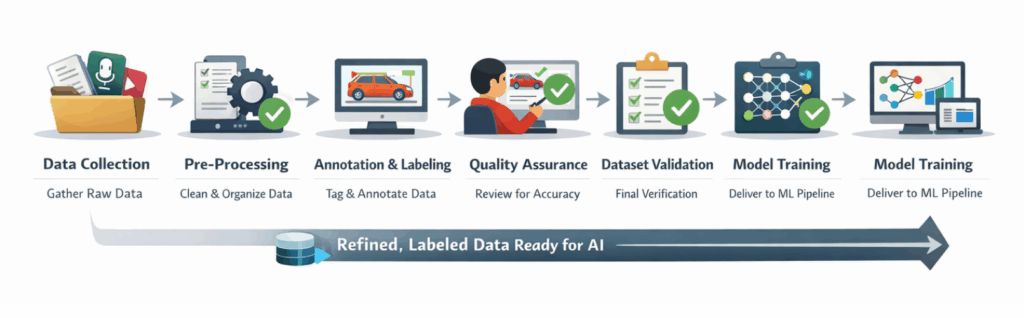
A data annotation pipeline is the structured workflow used to collect, label, review, and deliver training data for machine learning models. You can think of it as an assembly line for AI data. Raw information enters one side, and highly refined, structured data exits the other.
Typical pipeline stages include:
- Data collection: Gathering the raw images, text, or audio needed for the project.
- Pre-processing: Formatting and cleaning the raw files so annotators can easily work with them.
- Annotation / labeling: Human workers or automated systems attach meaningful tags to the data.
- Quality assurance review: Inspecting the labeled data to catch mistakes.
- Dataset validation: Final checks to ensure the batch meets project specifications.
- Delivery to ML training pipeline: Exporting the finished dataset for model training.
Quality assurance sits right between the initial annotation and the final dataset delivery. It acts as a necessary checkpoint to prevent poor-quality labels from entering the training data workflows.
What Is Annotation Quality Assurance?
Annotation quality assurance refers to the systematic process of reviewing, validating, and correcting labeled data to ensure accuracy and consistency before it reaches the machine learning training phase. It is the defensive shield protecting your AI data labeling process.
Effective QA involves extensively reviewing annotated samples and measuring overall label accuracy. When multiple annotators disagree on a specific label, QA teams step in to resolve these disagreements. They also enforce strict annotation guidelines across the entire workforce. Modern QA processes do not rely on a single method. Instead, they combine human reviewers, automated software checks, and statistical sampling to catch errors that a single approach might miss.
Why QA Is Critical in Data Annotation Pipelines
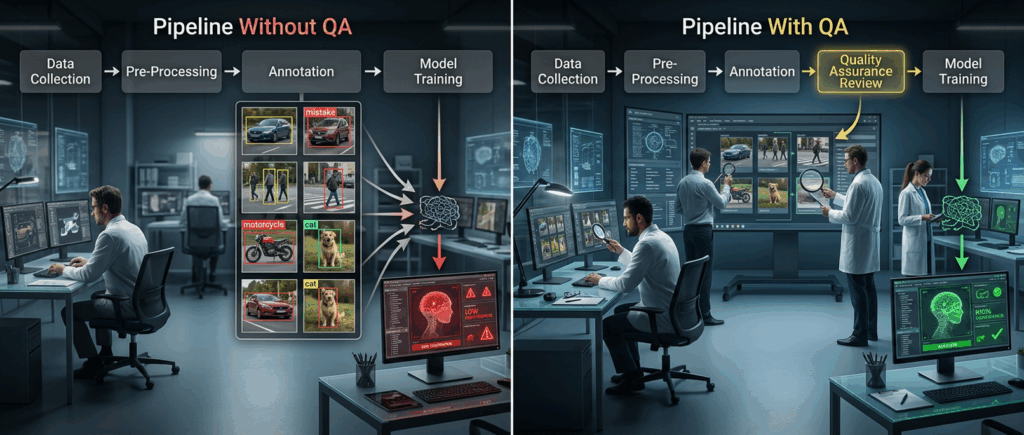
Skipping or rushing the QA step exposes AI projects to severe risks. Strong annotation quality assurance is critical for several fundamental reasons.
First, it directly prevents model performance issues. Incorrect labels lead to inaccurate predictions, causing the AI to fail in real-world scenarios. Second, rigorous QA reduces dataset noise. By removing inconsistent or conflicting annotations, you provide the model with a much clearer learning path.
Third, QA ensures annotation consistency. Multiple annotators will inevitably interpret complex guidelines differently. QA aligns their work to a single standard. Fourth, clean data improves training efficiency. Cleaner datasets allow ML models to converge faster, saving valuable computing time. Finally, high-quality data protects AI product reliability. High-risk applications like healthcare diagnostics, financial forecasting, or autonomous driving systems require absolute precision to function safely.
Key QA Processes Used in Annotation Pipelines
Organizations employ several operational methods to maintain high standards within their data annotation pipelines.
Multi-Layer Review Systems
The most common structural model moves data through multiple hands: Annotator → Reviewer → QA Auditor. Each distinct stage is designed to catch entirely different types of errors, drastically reducing the chance of a mistake slipping through.
Consensus Labeling
In this method, multiple annotators label the exact same data point. If their answers match, the label is approved. Disagreements are automatically flagged and resolved through a majority vote or by escalating the task to a senior expert reviewer.
Gold Standard Datasets
Project managers often seed the workflow with pre-labeled examples known as gold standard data. Annotators are secretly tested against these examples to constantly measure their individual accuracy and identify anyone needing additional training.
Random Sampling QA
Reviewing every single label is rarely cost-effective. Instead, QA teams review a mathematically significant percentage of the labeled data to detect systemic errors and calculate the overall batch quality.
Automated Quality Checks
Software tools handle the heavy lifting by automatically detecting missing labels, format errors, and glaring annotation inconsistencies before human reviewers even look at the file.
QA Metrics Used in Annotation Quality Assurance
You cannot improve what you cannot measure. High-performing annotation pipelines track several specific metrics continuously to maintain quality.
Common QA metrics include:
- Annotation Accuracy Rate: The percentage of completely correct labels calculated after a comprehensive QA review.
- Inter-Annotator Agreement (IAA): A mathematical measurement of consistency between different annotators working on the same project.
- Error Rate: The total percentage of incorrect labels detected during the review phase.
- Dataset Coverage: A tracking metric that ensures all required raw data has been successfully labeled and accounted for.
Challenges in Maintaining Annotation Quality
Maintaining flawless data annotation pipelines sounds straightforward on paper, but real-world execution presents massive difficulties.
Human subjectivity is a constant hurdle. Even with clear instructions, different annotators will interpret guidelines differently when faced with edge cases. Scaling annotation teams introduces another layer of friction. Large projects may require hundreds of annotators, making it incredibly hard to maintain consistent quality across the board.
Complex data types also slow down the review process. Video, audio, and multimodal datasets require highly specialized QA processes compared to simple text classification. Furthermore, evolving AI models mean that annotation guidelines frequently change right in the middle of model development. Organizations typically address these complex challenges using managed annotation teams and heavily structured QA frameworks.
Best Practices for Implementing QA in Data Annotation Pipelines
Building a reliable QA system requires a proactive approach. Here are the most effective ways to secure your pipeline.
Create Clear Annotation Guidelines: Detailed instructions and visual examples reduce ambiguity. Give your team a reliable reference document for edge cases.
Train Annotators Continuously: The learning process should not stop after onboarding. Regular feedback and scheduled retraining sessions directly improve long-term accuracy.
Implement Multi-Stage QA: Never rely on a single layer of review. Layered reviews systematically catch the errors that slip past the first round of checks.
Use QA Automation Tools: Let software handle the formatting errors. Automated tools help detect basic anomalies quickly, freeing up human reviewers to focus on complex subjective tasks.
Monitor Performance Metrics: Continuous monitoring of IAA and accuracy rates improves pipeline efficiency and highlights failing processes before they ruin a whole dataset.
How Managed Annotation Teams Improve QA
Many AI companies struggle immensely to build and maintain internal QA processes. Hiring, training, and managing hundreds of labeling contractors distracts core engineering teams from actually building the AI models.
Managed annotation providers solve this exact problem. They offer fully trained annotators, dedicated QA reviewers, and standardized annotation workflows right out of the box. Platforms like GetAnnotator provide monthly data annotators equipped with built-in quality assurance frameworks. This ensures that AI teams receive highly accurate, production-ready datasets on schedule, completely eliminating the need to manage large labeling teams internally.
The Future of Annotation Quality Assurance in AI
As AI models grow more sophisticated, the methods used to train them are shifting rapidly. Emerging trends in the industry include AI-assisted annotation QA, where smaller models check the work of human labelers. We are also seeing a rise in automated error detection and human-AI collaborative labeling. Real-time dataset validation is becoming the new standard. As AI systems become more complex, annotation quality assurance will become even more critical to the success of data annotation pipelines.
Building Reliable AI Systems Through Strong QA
Data annotation pipelines hold the immense responsibility of powering AI model training. Without strong QA mechanisms firmly in place, these datasets can easily introduce fatal errors and systemic bias into your machine learning projects. Annotation quality assurance is the only reliable way to ensure the accuracy, consistency, and scalability required for modern AI development.
Organizations are increasingly relying on structured QA frameworks and managed annotation teams to maintain these crucial high-quality datasets. Investing in robust annotation quality assurance is ultimately essential for building reliable, trustworthy, and scalable AI systems that actually perform in the real world.
FAQs
Annotation quality assurance is the process of reviewing and validating labeled data to ensure accuracy and consistency before it is used for machine learning training.
QA ensures that training datasets are accurate and reliable, which directly impacts AI model performance.
Common metrics include annotation accuracy, inter-annotator agreement, and error rate.
Organizations use multi-layer reviews, QA sampling, and managed annotation teams to maintain quality across large datasets.
 Previous Blog
Related Blogs

June 8, 2026
Why You Should Outsource Document Annotation
The demand for document artificial intelligence is growing rapidly across almost every industry. Organizations are constantly looking for ways to extract valuable insights from the massive volume of unstructured data they generate daily. High-quality annotated documents are essential for training the machine learning models that make this possible. Without accurately labeled data, even the most […]
Read More

June 5, 2026
Keypoint Annotation Outsourcing Guide for AI Teams
Building highly accurate computer vision models requires massive volumes of flawlessly labeled data. Machine learning engineers and data scientists face mounting pressure to deliver complex datasets rapidly. As computer vision applications evolve to recognize intricate movements and spatial relationships, basic labeling techniques fall short. Keypoint annotation has emerged as a critical requirement for modern AI […]
Read More

June 3, 2026
Scaling AI? Why You Should Outsource Text Annotation Services
Training a robust natural language processing (NLP) model requires massive amounts of high-quality data. AI algorithms do not inherently understand human language. They learn through carefully labeled datasets. Accurate text annotation provides the foundational context that allows AI systems to interpret nuances, sentiment, and user intent. As the complexity of AI models grows, so does […]
Read More

May 27, 2026
Building AI? Why You Need Trusted Data Annotation Platforms
The demand for high-quality AI training data is growing rapidly. Organizations are launching increasingly complex machine learning models, and these systems require massive amounts of accurately labeled data. Annotation quality directly impacts how well an AI model performs in the real world. A poorly trained model will make mistakes, cost your business money, and damage […]
Read More