

Enterprise Annotation Platform: The Key to Scalable AI Success
Artificial intelligence has moved beyond the experimental phase. For global organisations, AI is no longer just a buzzword; it is a critical driver of operational efficiency, customer experience, and competitive advantage. However, as companies attempt to move models from the research lab to production, many hit a significant wall: the data bottleneck.
Having sophisticated algorithms is meaningless if the data feeding them is inaccurate or insufficient. This is where an enterprise annotation platform becomes the lynchpin of success. It is not merely a tool for drawing boxes around cars or tagging parts of speech; it is a robust infrastructure designed to manage quality, security, and workforce scalability at a level that basic tools simply cannot match.
If you are leading an AI initiative, understanding the mechanics of these platforms is essential. This guide explores what defines an enterprise-grade solution, the critical features you must demand, and how to implement one to future-proof your machine learning pipeline.
Understanding the Enterprise Annotation Platform
At its core, an enterprise annotation platform is a comprehensive solution that facilitates the creation of high-quality training data for machine learning models. Unlike simple, open-source labelling tools used by hobbyists, an enterprise platform is built to handle the complexity, volume, and security requirements of large-scale businesses.
It bridges the gap between raw data and model-ready intelligence. Whether you are developing computer vision for autonomous vehicles or Natural Language Processing (NLP) for customer support chatbots, the platform serves as the central hub where data is ingested, annotated by human experts, reviewed for quality, and exported for training.
Crucially, modern platforms like GetAnnotator do not just provide software; they integrate the workforce into the ecosystem. They solve the “people problem” by connecting technical infrastructure with skilled, vetted annotators who understand specific domains, from medical imaging to legal document analysis.
What to Look for in an Enterprise Annotation Platform
Selecting the right partner is a high-stakes decision. A poor choice can lead to “technical debt,” where models degrade over time due to inconsistent data, forcing costly retraining cycles. When evaluating solutions, prioritize these four pillars:
1. Scalability and Performance
In the early stages of a project, managing five annotators on a spreadsheet might work. But what happens when you need to process a million images in a month? Or when a sudden shift in business strategy requires a 10x ramp-up in data throughput?
A true enterprise annotation platform offers elastic scalability. It allows you to rapidly expand your annotation capacity without a drop in performance or quality. This involves not just software that can handle large datasets without crashing, but a service model that can deploy hundreds of skilled annotators within days—not months.
2. Security and Compliance Features
For enterprises, data is often their most valuable asset. It is also frequently sensitive, containing Personally Identifiable Information (PII) or proprietary trade secrets.
Security cannot be an afterthought. Your platform must adhere to rigorous global standards. Look for SOC 2 Type II compliance, GDPR adherence, and ISO certifications. If you operate in healthcare, HIPAA compliance is non-negotiable. The platform should offer features such as:
- Role-based access controls (RBAC).
- Secure data transmission and storage encryption.
- Audit trails that log every interaction with a data point.
- Secure annotation environments that prevent data from being downloaded or stored locally by remote workers.
3. Support for Diverse Data Types
AI models are becoming multi-modal. A self-driving car system does not just look at 2D video; it analyzes LiDAR point clouds, reads street signs (text), and processes audio signals.
An effective enterprise annotation platform must be versatile. It should support a wide array of data types, including:
- Computer Vision: Bounding boxes, polygons, semantic segmentation, and keypoint annotation.
- NLP: Named Entity Recognition (NER), sentiment analysis, and text classification.
- Audio & Video: Transcription, temporal labelling, and object tracking.
This versatility ensures that as your AI initiatives evolve, you do not need to procure and integrate a new platform for every new data type.
4. Collaboration and Workflow Management
Data annotation is a team sport involving annotators, reviewers, project managers, and data scientists. A platform must facilitate seamless collaboration between these groups.
Look for tools that offer real-time communication, integrated feedback loops, and robust project management dashboards. You should be able to track productivity metrics, monitor individual annotator performance, and easily flag ambiguous data for review by a domain expert. This prevents the “silo” effect where annotators work in isolation, leading to drift in data quality.
How to Implement an Enterprise Annotation Platform
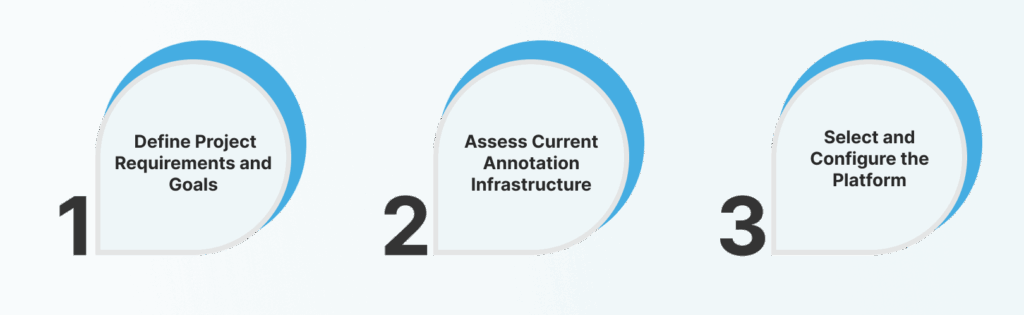
Transitioning to an enterprise solution requires a strategic approach. Rushing the implementation can lead to friction and wasted resources.
Step 1: Define Project Requirements and Goals
Before you sign a contract, be crystal clear about your objectives.
- What is the specific use case? (e.g., detecting defects in manufacturing lines).
- What is the volume of data?
- What level of accuracy is required? (e.g., 99.5% for medical diagnosis vs. 90% for retail sentiment analysis).
- What is the timeline?
Having these answers helps you select the right subscription tier or service level, ensuring you are not overpaying for unnecessary features or under-resourcing critical tasks.
Step 2: Assess Current Annotation Infrastructure
Conduct an audit of your current process. Are you relying on expensive in-house data scientists to draw bounding boxes? This is a massive drain on ROI. Are you using crowdsourced platforms with anonymous workers? This poses security risks.
Identify the bottlenecks in your current workflow. Is it speed? Is it the lack of domain expertise? Understanding your pain points will help you configure the new platform to solve those specific issues.
Step 3: Select and Configure the Platform
Once you choose a partner like GetAnnotator, the setup phase begins. This involves integrating the platform with your data pipelines (e.g., AWS S3 buckets or Azure Blob Storage).
Configuration also involves setting up the “human” side of the platform. You will work with the provider to select annotators with the right subject matter expertise—ensuring that a radiologist looks at X-rays and a linguist looks at legal contracts.
Best Practices for Enterprise Annotation
The tool is only as effective as the process governing it. To extract the maximum value from your enterprise annotation platform, adhere to these best practices.
Training and Quality Assurance
Even the most intuitive platform requires clear instructions. You must develop a “Gold Standard”—a set of perfectly annotated data that serves as the benchmark.
Invest time in creating detailed guidelines that cover edge cases. For example, in an image of a street, should a car that is 50% occluded by a tree be labelled? Detailed guidelines prevent subjective interpretation.
Furthermore, utilize the platform’s QA features. Implement a consensus mechanism where multiple annotators label the same asset, and the platform only accepts the annotation if they agree. This statistical validation is the hallmark of enterprise-quality data.
Continuous Monitoring and Improvement
Annotation is not a “set it and forget it” task. It is an iterative loop. As your model begins to learn, it will struggle with certain classes of data. You need to feed this information back into the annotation platform.
Use the platform’s analytics to monitor throughput and error rates. If a specific annotator is struggling with a certain task, offer targeted retraining. If the model is failing to detect specific objects, prioritize the annotation of more data containing those objects. This active learning cycle creates a flywheel effect, constantly improving model performance.
Conclusion
The difference between a stalled AI pilot and a successful enterprise deployment often comes down to data. While algorithms grab the headlines, it is the quality of the training data that determines the reliability of the result.
An enterprise annotation platform is the infrastructure that guarantees this reliability. By offering scalability, robust security, diverse data support, and expert management, platforms like GetAnnotator transform data labelling from a logistical nightmare into a streamlined competitive advantage.
As you look to scale your AI capabilities, remember that your internal teams should be focused on innovation, not data cleaning. Partnering with a dedicated platform allows you to offload the heavy lifting of annotation to professionals, ensuring your models are built on a foundation of truth.
 Previous Blog
Related Blogs

June 5, 2026
Keypoint Annotation Outsourcing Guide for AI Teams
Building highly accurate computer vision models requires massive volumes of flawlessly labeled data. Machine learning engineers and data scientists face mounting pressure to deliver complex datasets rapidly. As computer vision applications evolve to recognize intricate movements and spatial relationships, basic labeling techniques fall short. Keypoint annotation has emerged as a critical requirement for modern AI […]
Read More

June 3, 2026
Scaling AI? Why You Should Outsource Text Annotation Services
Training a robust natural language processing (NLP) model requires massive amounts of high-quality data. AI algorithms do not inherently understand human language. They learn through carefully labeled datasets. Accurate text annotation provides the foundational context that allows AI systems to interpret nuances, sentiment, and user intent. As the complexity of AI models grows, so does […]
Read More

May 27, 2026
Building AI? Why You Need Trusted Data Annotation Platforms
The demand for high-quality AI training data is growing rapidly. Organizations are launching increasingly complex machine learning models, and these systems require massive amounts of accurately labeled data. Annotation quality directly impacts how well an AI model performs in the real world. A poorly trained model will make mistakes, cost your business money, and damage […]
Read More

May 19, 2026
Freelance Data Annotators for Hire: Finding AI Experts
Artificial intelligence is only as good as the data it learns from. As the demand for AI models grows across every industry, the need for high-quality training data has skyrocketed right alongside it. Machine learning algorithms require massive amounts of accurately labeled information to function properly, driving businesses to seek out skilled professionals who can […]
Read More