

- What Are Dedicated Data Annotators?
- What Are Data Annotation Platforms?
- Key Differences: Dedicated Annotators vs Platforms
- Hidden Limitations of Data Annotation Platforms
- Benefits of Hiring Dedicated Data Annotators
- When Should You Choose Dedicated Data Annotators?
- When Platforms Might Still Work
- Real-World Scenario: The Cost of Inconsistency
- How to Hire the Right Dedicated Data Annotators
- Why GetAnnotator Is the Right Choice
- Secure Your AI Success with High-Quality Data
- FAQs
Why Hire Dedicated Data Annotators Over Platforms?
Struggling with inconsistent annotations, missed deadlines, or poor-quality datasets? You are not alone. As machine learning models become more advanced, the demand for highly accurate training data has skyrocketed. AI success depends heavily on the quality of the data feeding it. If you feed a model poorly labeled data, you will get poor predictions.
When looking for data labeling solutions, most AI teams face a common dilemma: should you use a crowdsourced platform or hire dedicated data annotators?
Platforms offer quick access to a massive workforce, while dedicated teams provide specialized, long-term focus. Making the wrong choice can lead to delayed product launches, expensive rework, and failed AI initiatives. This guide will help you understand the core differences so you can make a smarter, ROI-driven decision for your next project.
What Are Dedicated Data Annotators?
Dedicated data annotators are skilled professionals—or entire teams—exclusively assigned to your specific project. Instead of picking up random tasks from a queue, they work directly on your datasets for the duration of your contract.
These teams typically possess deep domain expertise, making them ideal for specialized fields like healthcare, autonomous driving, or natural language processing (NLP). Because they engage in long-term projects, they adapt to your custom workflows and undergo specific training tailored to your AI model’s needs. This is a stark contrast to platforms, which rely heavily on a crowdsourced, gig-based workforce.
What Are Data Annotation Platforms?
Data annotation platforms are self-serve or semi-managed software solutions that connect you with a distributed network of gig workers.
These platforms feature on-demand access to a large workforce, automated labeling tools, and pay-per-task pricing models. They allow you to upload your data, set some basic guidelines, and let the crowd handle the rest. Platforms work quite well for small-scale, low-complexity projects where you need basic image tagging or sentiment analysis done quickly. However, when quality and consistency truly matter, the limitations of the crowdsourced model quickly appear.
Key Differences: Dedicated Annotators vs Platforms
To understand which approach is best for your ML team, you need to look at how they compare across several critical factors.
Quality and Accuracy
Dedicated annotators are trained specifically for your use case. Because they work on your data day in and day out, they deliver much higher consistency and precision. Platforms rely on a rotating cast of gig workers with highly variable skill levels, significantly increasing the risk of inconsistent labeling across your dataset.
Domain Expertise
If your AI model requires industry-specific knowledge—such as reading medical charts, understanding legal jargon, or identifying retail SKUs—dedicated teams are essential. Platforms generally offer a generalized workforce with very limited specialization, making them unsuitable for highly technical tasks.
Data Security and Confidentiality
Security is a major concern for enterprise AI. Dedicated data annotators usually work in controlled environments, sign strict non-disclosure agreements (NDAs), and adhere to compliance standards like GDPR or HIPAA. Platforms distribute your data across thousands of personal computers worldwide, creating a much higher exposure risk for sensitive information.
Scalability and Flexibility
Dedicated teams are highly scalable and integrate directly into your custom workflows. While platforms offer fast initial scaling, you sacrifice control over workforce quality. Adding more gig workers often means adding more errors.
Communication and Control
With dedicated annotators, you have direct communication channels and real-time feedback loops. If an edge case arises, you can clarify it immediately. Platforms offer limited control and indirect communication, meaning you often only discover systematic errors after the tasks are completed and paid for.
Cost vs Value
Platforms boast lower upfront costs, but they often hide the true cost of rework, poor quality, and delayed timelines. Dedicated annotators require a higher initial investment, but they deliver a much better long-term ROI by getting the data right the first time.
Hidden Limitations of Data Annotation Platforms
While the pay-per-task model looks appealing on paper, platforms come with severe hidden drawbacks. You will likely experience inconsistent outputs across different annotators, leading to a messy dataset. Because the workforce is anonymous, there is a distinct lack of accountability.
Furthermore, platforms struggle with complex annotation tasks that require deep context. This leads to high rework rates that destroy project timelines. Finally, the quality assurance processes on these platforms are often automated or handled by other crowdsourced workers, creating a weak safety net for your data.
Benefits of Hiring Dedicated Data Annotators
Choosing to hire dedicated data annotators brings a massive shift in how your data pipeline operates.
Superior Data Quality
You get total consistency across your datasets. This directly translates to reduced model errors and better overall AI performance.
Faster Project Turnaround
With a dedicated team, you completely bypass the repeated onboarding and training cycles required when gig workers churn. The workflows are streamlined, keeping your project moving efficiently.
Customized Annotation Workflows
Your team follows tailored guidelines designed specifically for your AI model. As your model evolves, the team makes iterative improvements to the labeling criteria.
Strong Quality Assurance (QA) Processes
Dedicated setups feature multi-level QA checks and continuous performance monitoring, ensuring edge cases are caught and corrected early.
Better Collaboration
You benefit from direct communication with the annotators. When guidelines change, you can implement feedback instantly.
Long-Term Partnership Value
Over time, a dedicated team retains knowledge about your project. This continuous improvement in annotation quality makes them a true extension of your ML team.
When Should You Choose Dedicated Data Annotators?
You should invest in a dedicated team when your project involves complex data, such as medical images, LiDAR point clouds, or nuanced NLP tasks. They are also the right choice for large-scale datasets, projects with strict accuracy requirements, or anything involving sensitive and confidential data. If you are building a long-term AI development pipeline, dedicated experts are essential.
When Platforms Might Still Work
Platforms are not entirely obsolete. They are perfectly fine for small pilot projects or low-budget experiments. If you have non-critical annotation tasks or need to do some quick prototyping to test an initial hypothesis, a crowdsourced platform can get the job done fast.
Real-World Scenario: The Cost of Inconsistency
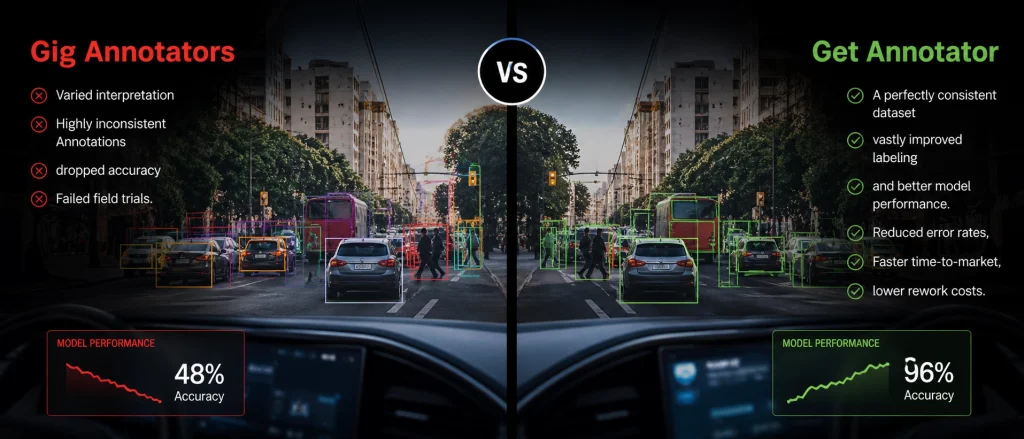
Consider an AI startup building a computer vision model for autonomous drones. Initially, they used a crowdsourced platform to label obstacles. Because the gig workers varied in their interpretation of “obstacle boundaries,” the annotations were highly inconsistent. The model’s accuracy dropped significantly during testing, leading to failed field trials.
The startup then switched to dedicated data annotators. The new team underwent specific training on drone spatial awareness. The result? A perfectly consistent dataset, vastly improved labeling, and better model performance. The startup saw drastically reduced error rates, faster time-to-market, and lower overall rework costs.
How to Hire the Right Dedicated Data Annotators
Finding the right team requires a bit of vetting. Look for a provider with proven experience in your specific domain. Ensure they have strong QA processes and clear scalability capabilities. You must also verify their data security compliance and look for transparent pricing models so you aren’t hit with surprise fees.
Your best option is to choose a trusted, industry-leading provider like GetAnnotator.
Why GetAnnotator Is the Right Choice
GetAnnotator provides AI startups and enterprises with highly skilled, trained annotation teams that seamlessly integrate into your workflows. We offer domain-specific expertise to ensure your complex datasets are handled with precision.
With our end-to-end data annotation services, you benefit from strong QA frameworks, strict compliance standards, and highly flexible engagement models. Our proven track record means you can stop worrying about data quality and get back to building incredible AI models.
Secure Your AI Success with High-Quality Data
Platforms may seem convenient for a quick task, but dedicated data annotators deliver the reliability, quality, and ROI required for serious ML projects. If your AI success depends on data quality, it is time to invest in dedicated expertise.
Stop settling for inconsistent datasets. Contact GetAnnotator today to request a demo or start a pilot project, and see the difference a dedicated team can make.
FAQs
Ans: – Dedicated data annotators are professionals exclusively assigned to label and categorize data for your specific machine learning project, providing consistent and high-quality outputs.
Ans: – Yes, for complex or long-term projects. They provide higher accuracy, better security, and stronger domain expertise compared to the anonymous gig workers found on platforms.
Ans: – Platforms often have lower upfront costs, but they frequently result in hidden expenses due to high rework rates, poor quality data, and delayed project timelines.
Ans: – Platforms are suitable for basic tasks, small low-budget experiments, or quick prototyping where absolute precision is not the primary goal.
Ans: – They provide highly consistent, accurate training data that helps the machine learning algorithm learn correct patterns, directly reducing model errors.
Ans: – Absolutely. Dedicated teams work under strict NDAs in secure, compliant environments (like GDPR and HIPAA), whereas platforms distribute your data to thousands of personal devices.
Ans: – Yes. Professional annotation providers can easily scale your dedicated team up or down based on your evolving data volume requirements.
Ans: – Look for specialized data annotation companies, like GetAnnotator, that offer transparent pricing, strict QA processes, and domain-specific expertise for your industry.
 Previous Blog
Related Blogs

April 25, 2026
How to Hire Linguistics Freelancers for AI Data
Artificial intelligence models rely on massive amounts of high-quality language data to function properly. Whether you are building natural language processing (NLP) algorithms, speech recognition tools, or complex multilingual models, accurate data annotation is essential. However, simply labeling text or audio is no longer enough to train advanced AI. Linguistics expertise matters because human language […]
Read More

April 3, 2026
What is Annotation Throughput? Tasks per Hour Explained
Building a successful artificial intelligence model requires massive amounts of labeled data. As teams push to scale their AI models, the demand for high-quality data annotation grows exponentially. Speed becomes a critical factor. The faster your team can accurately label data, the sooner your machine learning models can move from development to production. This brings […]
Read More

March 30, 2026
Bounding Box vs. Polygon Annotation: A Complete Guide
Training an AI model to “see” requires massive amounts of labeled data. Image annotation acts as the foundational layer of computer vision, teaching algorithms how to identify and understand objects within digital images. The specific annotation method you choose directly impacts how your AI model interprets the world, fundamentally influencing its overall accuracy and performance. […]
Read More

March 26, 2026
How to Scale Annotation Teams for Growing AI Projects
The rapid growth of artificial intelligence projects has triggered a massive demand for high-quality labeled data. As your machine learning models become more complex, the volume of data required to train them multiplies. This sudden need for data makes scaling annotation teams a critical bottleneck for many AI initiatives. If you fail to scale these […]
Read More