
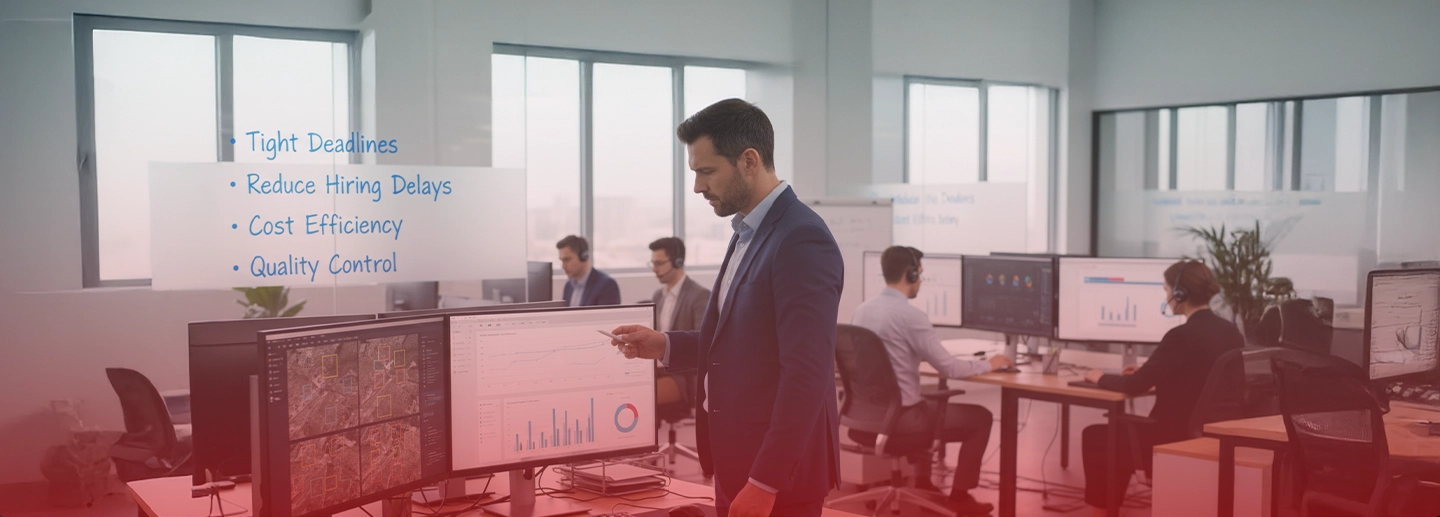
- Why Traditional Hiring Methods Fail for Data Annotation
- What Does It Mean to Hire Data Annotators Without Middlemen?
- Key Skills to Look for When You Hire Data Annotators
- Step-by-Step Process to Hire Data Annotators Without Delays
- Benefits of Hiring Dedicated Annotators Directly
- Common Mistakes to Avoid When You Hire Data Annotators
- In-House vs Agency vs Dedicated Annotators
- When Should You Switch from Agencies to Dedicated Annotators?
- How GetAnnotator Helps You Hire Data Annotators Without Middlemen
- Use Cases: Who Benefits Most from Direct Annotation Hiring?
- Skip the Middlemen and Build Better AI Models
- FAQs
How to Hire Data Annotators Without Middlemen or Delays
Building accurate AI models starts with high-quality training data. But getting that data labeled correctly often means navigating slow hiring cycles, expensive agencies, or unreliable freelance platforms. For AI teams working under tight deadlines, these obstacles can derail entire projects.
There’s a better approach: hiring data annotators directly. This method eliminates intermediaries, cuts costs, and gives you full control over quality and timelines. When you hire data annotators without middlemen, you gain access to skilled professionals who can start working on your project within days—not weeks.
In this guide, you’ll learn how to hire data annotators faster, cheaper, and smarter.
Why Traditional Hiring Methods Fail for Data Annotation
Most organizations start their search for annotation talent through one of three channels: agencies, freelance platforms, or in-house hiring. Each option comes with significant drawbacks.
Agencies create bottlenecks at every stage. They add high commission fees—often 30-50% on top of annotator costs. Communication flows through multiple layers, slowing down feedback loops and project adjustments. Quality control becomes inconsistent because you’re separated from the people doing the actual work.
Freelance platforms promise flexibility but deliver chaos. Skills vary wildly between annotators, making it difficult to maintain consistency across large datasets. High turnover means you’re constantly onboarding new people and explaining your guidelines from scratch. There’s little accountability when quality drops or deadlines slip.
In-house hiring sounds ideal until you consider the overhead. Training new annotators takes weeks. HR processes consume valuable time and resources. Scaling up or down becomes rigid and expensive. You end up managing people instead of focusing on your AI models.
These traditional methods weren’t designed for the speed and precision AI projects demand.
What Does It Mean to Hire Data Annotators Without Middlemen?
Direct hiring means connecting with annotation professionals without agencies or platforms taking a cut. Instead of paying commissions to intermediaries, you work with dedicated annotators who become extensions of your team.
This model differs fundamentally from marketplace freelancers, who work across multiple clients simultaneously, and BPO agencies that manage large pools of generalized workers. Dedicated annotation teams focus exclusively on your projects, learning your specific requirements and improving quality over time.
The benefits are immediate and measurable:
- Faster onboarding — Teams can start within 24-48 hours instead of waiting weeks for agency coordination.
- Direct communication — You speak directly with annotators, clarifying guidelines and addressing questions in real-time.
- Transparent pricing — You see exactly what you’re paying for talent and management, with no hidden fees.
- Better data security — Fewer parties handling your datasets means reduced risk and easier compliance management.
When you hire dedicated annotators directly, you’re not just filling roles—you’re building relationships with professionals invested in your success.
Key Skills to Look for When You Hire Data Annotators
Not all annotators bring the same capabilities to your project. The right fit depends on your specific data types and quality requirements.
Technical skills form the foundation. Look for experience with your annotation types—whether that’s bounding boxes and polygon annotation for computer vision, semantic segmentation for autonomous vehicles, or NLP tagging for text classification. Annotators should be comfortable with standard tools and able to adapt to your platform preferences.
Soft skills separate good annotators from great ones. Attention to detail determines whether your model learns correct patterns or inherits systematic errors. Consistency ensures annotations remain uniform across thousands of images or documents. The ability to follow complex guidelines without constant supervision saves your team countless review hours.
Industry experience matters more than many teams realize. Healthcare annotations require understanding of medical terminology. Autonomous driving datasets need annotators familiar with traffic scenarios and edge cases. Retail product classification demands knowledge of category structures and visual attributes.
Quality metrics provide objective benchmarks. Target annotators who consistently achieve 95%+ accuracy rates on pilot tasks. Check for strong inter-annotator agreement scores, which indicate they interpret guidelines the same way as your team and other annotators.
Step-by-Step Process to Hire Data Annotators Without Delays
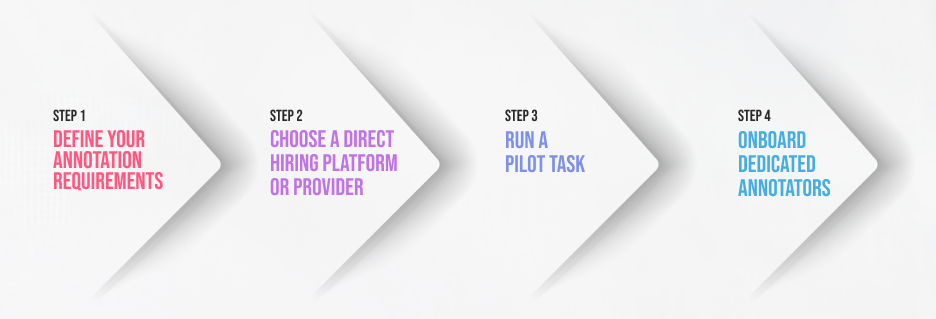
Step 1: Define Your Annotation Requirements
Start by clarifying exactly what you need. Document your dataset type (images, video, text, audio), total volume, required accuracy level, and turnaround time. Include any security or compliance needs upfront—these factors influence which annotators you can work with.
Precise requirements prevent mismatches and false starts that waste weeks of project time.
Step 2: Choose a Direct Hiring Platform or Provider
Look for services that offer pre-vetted annotators without charging platform commissions. The best providers operate on subscription models rather than percentage-based fees, giving you predictable costs as you scale.
Dedicated teams work best for scaling projects because annotators develop deep familiarity with your data and guidelines. This reduces errors and accelerates throughput over time.
Step 3: Run a Pilot Task
Never commit to full production without testing. Create a small batch annotation task that represents your actual project complexity. Measure accuracy, speed, and communication quality during this trial period.
Use pilot results to filter top performers and identify who should move forward to your main project. This step catches problems early when they’re easy to fix.
Step 4: Onboard Dedicated Annotators
Provide clear, comprehensive annotation guidelines that define every label and edge case. Establish a QA workflow with regular review checkpoints. Define service level agreements (SLAs) for turnaround times and quality thresholds. Create a feedback loop so annotators can flag ambiguous cases and improve your guidelines.
Proper onboarding transforms individual annotators into a coordinated team aligned with your quality standards.
Benefits of Hiring Dedicated Annotators Directly
The advantages of direct hiring compound over time. Cost efficiency stands out immediately—eliminating agency commissions can reduce your per-annotation cost by 40-50%. You pay for the work, not the overhead of multiple intermediaries.
Faster turnaround becomes possible when communication happens directly. Questions get answered in hours instead of days. Adjustments to guidelines propagate immediately rather than filtering through account managers and project coordinators at an agency.
Custom-trained workforce emerges as your biggest long-term asset. When you hire dedicated annotators, they learn the nuances of your data. They understand which edge cases matter and which can be handled with standard rules. This institutional knowledge is impossible to build with rotating freelancers.
Higher accuracy follows naturally from specialized focus. Dedicated teams aren’t context-switching between your project and five others. They develop expertise in your specific domain and annotation requirements.
Data privacy becomes simpler to manage. Fewer parties accessing your datasets means fewer security reviews and compliance audits. You can implement stricter controls without coordinating across multiple vendors.
Long-term scalability works smoothly because you’re not starting from scratch each time you expand. Add more annotators from the same provider and they integrate seamlessly with your existing team and processes.
Common Mistakes to Avoid When You Hire Data Annotators
Hiring without tests wastes everyone’s time. Even experienced annotators need to prove they can handle your specific requirements. Always run a pilot before committing to production volumes.
Ignoring QA until problems surface costs you model performance. Build review processes into your workflow from day one. Catch systematic errors early before they contaminate your entire dataset.
Operating without clear annotation guidelines creates chaos. Annotators can’t read your mind. Document every decision rule, edge case, and label definition. Update guidelines as new scenarios emerge.
Over-optimizing for cost backfires on quality. The cheapest annotators usually deliver the lowest accuracy. Focus on value—what does a 2% improvement in annotation quality mean for your model’s performance?
Failing to plan for scalability leaves you scrambling. Start with a provider who can grow with you. Hiring and training new annotators mid-project disrupts momentum and introduces quality variations.
In-House vs Agency vs Dedicated Annotators
| Factor | In-House Hiring | Agency | Dedicated Annotators |
| Cost | $7,000-10,000+/month per annotator | $3,000-5,000+/month + 30-50% markup | Starting at $500/month all-inclusive |
| Speed | 2-4 weeks to hire | 1-2 weeks | 24-48 hours |
| Quality | High (if trained well) | Variable | High (pre-vetted + trained) |
| Scalability | Slow, requires new hires | Moderate | Fast, on-demand |
| Control | Full control | Limited visibility | Direct oversight |
Dedicated annotators without middlemen offer the best balance of cost, speed, and quality for most AI teams. You get the control of in-house hiring without the overhead, and the scalability of agencies without the markup.
When Should You Switch from Agencies to Dedicated Annotators?
Certain signals indicate it’s time to reevaluate your annotation sourcing strategy.
Your dataset size keeps growing. If you’re moving from thousands to millions of annotations, agency fees become prohibitively expensive. Dedicated teams scale more efficiently at high volumes.
Accuracy remains inconsistent despite multiple rounds of feedback. This suggests poor communication between you and the annotators doing the work. Direct relationships solve this problem.
Agency costs keep rising without corresponding quality improvements. Middlemen extract value without adding it. Moving to dedicated annotators reallocates those dollars to talent and tools.
You need domain-trained annotators who understand your industry. Generic agency pools rarely provide specialized expertise. Direct hiring lets you select for specific backgrounds and experience.
How GetAnnotator Helps You Hire Data Annotators Without Middlemen
GetAnnotator connects you directly with skilled annotation professionals through a subscription model that eliminates commissions and delays.
The platform provides direct access to pre-vetted annotators with proven track records across multiple annotation types. No platform commissions eat into your budget—you pay a flat monthly fee for dedicated team members.
Domain-specific teams match your project requirements. Whether you’re working on medical imaging, autonomous vehicle datasets, or NLP applications, GetAnnotator assigns annotators with relevant industry experience.
Fast onboarding gets your team working within 24 hours of subscription. Built-in QA workflows maintain quality standards throughout the project lifecycle. Secure data handling protocols ensure compliance with GDPR, ISO 27001, and industry-specific regulations.
Flexible scaling lets you adjust team size based on project demands. Add annotators during peak periods or reduce capacity between milestones—all within the same subscription framework.
Instead of managing freelancers or paying agency markups, GetAnnotator connects you directly with skilled annotation professionals who become extensions of your team.
Use Cases: Who Benefits Most from Direct Annotation Hiring?

Computer vision startups building object detection or image classification models need consistent, high-quality bounding box and segmentation annotations. Direct hiring provides the volume and accuracy required for competitive model performance.
NLP model training for sentiment analysis, entity recognition, or text classification demands annotators who understand linguistic nuances. Dedicated teams develop this expertise faster than rotating freelancers.
Healthcare AI companies working with medical imaging or clinical data require annotators with domain knowledge and strict compliance with privacy regulations. Direct relationships simplify security audits and ensure proper handling of sensitive information.
Autonomous vehicle datasets involve complex scenarios requiring precise annotations of vehicles, pedestrians, road signs, and lane markings. Experienced annotators who understand traffic patterns and edge cases deliver better training data.
Retail and ecommerce models for product categorization, visual search, and recommendation systems benefit from annotators familiar with product taxonomies and consumer behavior patterns.
Skip the Middlemen and Build Better AI Models
Traditional hiring methods slow you down with agency fees, freelancer turnover, and internal overhead. These obstacles don’t just waste money—they delay your model development and compromise data quality.
Direct hiring solves these problems. When you hire data annotators without middlemen, you gain cost efficiency, faster turnaround, and higher accuracy. Dedicated teams become extensions of your organization, learning your requirements and improving over time.
If you’re ready to hire data annotators without delays or middlemen, dedicated teams offer the smartest path forward. Start with a small pilot project to test the model, then scale your annotation team as your datasets grow.
GetAnnotator makes this transition seamless. Sign up today and get your dedicated annotation team working within 24 hours—no sales calls, no complicated contracts, just skilled professionals ready to tackle your data labeling needs.
FAQs
Costs vary based on annotation complexity and required expertise. Direct hiring through platforms like GetAnnotator starts at $500/month for a dedicated annotator, compared to $3,000-5,000+ through agencies. You save 40-50% by eliminating middleman commissions.
Dedicated annotators focus exclusively on your projects, developing deep familiarity with your guidelines and data. Freelancers split attention across multiple clients, leading to inconsistent quality and higher turnover. Dedicated teams deliver better accuracy and faster turnaround.
With direct hiring platforms, onboarding happens within 24-48 hours. Traditional agency arrangements require 1-2 weeks. In-house hiring takes 2-4 weeks minimum between posting positions, interviewing, and training.
Start with a pilot task to test accuracy before full production. Implement regular QA reviews with clear acceptance criteria. Provide detailed annotation guidelines and maintain open communication channels for questions. Track metrics like inter-annotator agreement to identify issues early.
Reputable direct hiring platforms implement strict security protocols including NDA requirements, secure data transfer methods, and compliance with GDPR and ISO 27001 standards. Verify security measures before sharing sensitive datasets.
 Previous Blog
Related Blogs

June 8, 2026
Why You Should Outsource Document Annotation
The demand for document artificial intelligence is growing rapidly across almost every industry. Organizations are constantly looking for ways to extract valuable insights from the massive volume of unstructured data they generate daily. High-quality annotated documents are essential for training the machine learning models that make this possible. Without accurately labeled data, even the most […]
Read More

June 5, 2026
Keypoint Annotation Outsourcing Guide for AI Teams
Building highly accurate computer vision models requires massive volumes of flawlessly labeled data. Machine learning engineers and data scientists face mounting pressure to deliver complex datasets rapidly. As computer vision applications evolve to recognize intricate movements and spatial relationships, basic labeling techniques fall short. Keypoint annotation has emerged as a critical requirement for modern AI […]
Read More
June 3, 2026
Scaling AI? Why You Should Outsource Text Annotation Services
Training a robust natural language processing (NLP) model requires massive amounts of high-quality data. AI algorithms do not inherently understand human language. They learn through carefully labeled datasets. Accurate text annotation provides the foundational context that allows AI systems to interpret nuances, sentiment, and user intent. As the complexity of AI models grows, so does […]
Read More

May 27, 2026
Building AI? Why You Need Trusted Data Annotation Platforms
The demand for high-quality AI training data is growing rapidly. Organizations are launching increasingly complex machine learning models, and these systems require massive amounts of accurately labeled data. Annotation quality directly impacts how well an AI model performs in the real world. A poorly trained model will make mistakes, cost your business money, and damage […]
Read More