

- What Is Human-in-the-Loop AI?
- What Is HITL Machine Learning?
- Why Human-in-the-Loop AI Matters
- Key Benefits of Human-in-the-Loop AI
- How Human-in-the-Loop AI Works (Step-by-Step)
- Common Use Cases of Human-in-the-Loop AI
- Human-in-the-Loop vs. Fully Automated AI
- Challenges in Implementing HITL AI
- How GetAnnotator Supports Human-in-the-Loop AI
- Future of Human-in-the-Loop AI
- Conclusion
Human-in-the-Loop AI Explained: Meaning, Benefits & Use Cases
We often think of Artificial Intelligence as a completely autonomous force—a system that learns, predicts, and acts entirely on its own. While the goal of AI is often automation, the reality of building reliable models is quite different. AI systems rely heavily on data, and when that data is messy or ambiguous, models make mistakes.
A self-driving car might mistake a plastic bag for a rock, or a customer service chatbot might misinterpret a sarcastic complaint as a compliment. These edge cases happen because AI lacks human context and intuition. To bridge this gap, data scientists turn to human in the loop AI.
By combining the processing power of machines with the judgment of humans, businesses can create systems that are not only faster but also significantly more accurate. This approach is the backbone of high-performing models, and companies like GetAnnotator exist to streamline this critical collaboration between human intelligence and machine efficiency.
What Is Human-in-the-Loop AI?
Human in the loop AI is a model development strategy where human interaction is integrated directly into the AI system’s learning and decision-making process. Rather than launching a model and hoping for the best, humans remain involved to guide the system.
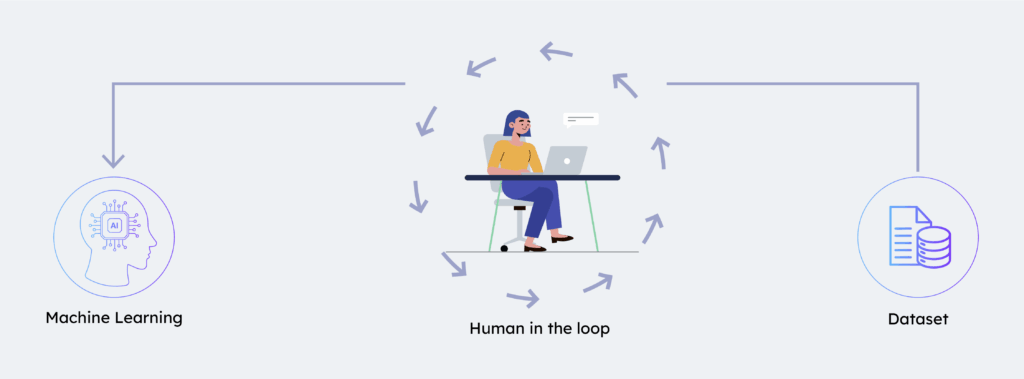
This involvement typically happens across three stages:
- Data Labeling: Humans categorize raw data so the model can understand what it is looking at.
- Model Training: Humans provide the ground truth that the model uses to learn patterns.
- Prediction Review: When the model is unsure about a prediction (a low confidence score), a human steps in to verify or correct it.
The difference between fully automated AI and human-assisted AI is the safety net. In a fully automated system, the machine decides the outcome regardless of its confidence level. In a human-in-the-loop system, the workflow looks like this:
Data → Model Prediction → Human Review (if uncertain) → Model Improvement
What Is HITL Machine Learning?
While the broader concept covers any human involvement, HITL machine learning refers specifically to the feedback loop that improves the algorithm over time. It is a continuous cycle of learning.
In this process, human feedback isn’t just a one-time fix; it becomes new training data. When a human corrects a chatbot’s response or adjusts a bounding box on an image, that correction is fed back into the system. The model re-trains on this new information, learning from its specific mistakes. This approach connects closely with active learning, where the model explicitly asks for help on the data points it finds most confusing, ensuring that human effort is spent where it provides the most value.
Why Human-in-the-Loop AI Matters
Relying on fully automated AI without human oversight can lead to significant operational risks. Algorithms are only as good as the data they are fed, and they often struggle with:
- Biased predictions inherited from skewed historical data.
- Edge cases that the model has never seen before.
- Low-quality training data that confuses the algorithm.
In sensitive industries like healthcare or finance, a wrong prediction can have legal or safety consequences. Human in the loop AI mitigates these risks. Humans act as the ultimate validator, ensuring that data quality is high and that the model’s behavior aligns with real-world expectations. By catching mistakes before they impact the end user, humans transform a fragile system into a robust one.
Key Benefits of Human-in-the-Loop AI
Implementing a human-centric approach does more than just fix errors; it fundamentally upgrades the capability of your AI.
Higher Model Accuracy
The most immediate benefit is precision. When humans correct wrong predictions, the model stops guessing and starts knowing. Over time, these corrections refine the algorithm’s parameters, leading to consistently higher accuracy rates.
Better Data Quality
Raw data is often noisy or mislabeled. Human annotation ensures that the foundational data used for training is reliable. A clean dataset leads to a smarter model, whereas a noisy dataset leads to unreliable outputs.
Reduced Bias and Errors
AI can inadvertently amplify societal biases found in training data. Humans are necessary to detect biased outputs—such as a hiring algorithm favoring one demographic over another—and correct the course to create fairer systems.
Faster Model Improvement
HITL machine learning accelerates the path to deployment. Instead of waiting to retrain a model from scratch after a failure, the feedback loop allows for incremental improvements. The model learns faster because it is constantly being course-corrected.
Safer AI for Critical Applications
In high-stakes environments, such as medical diagnosis or autonomous systems, 99% accuracy isn’t good enough. The human loop provides the necessary oversight to ensure safety protocols are met before an AI decision is acted upon.
How Human-in-the-Loop AI Works (Step-by-Step)
The process of integrating humans into the AI lifecycle usually follows a specific sequence designed to maximize efficiency.
- Prediction: The AI model encounters a piece of data (an image, a text string, or a transaction) and makes a prediction.
- Confidence Check: The system assigns a confidence score to that prediction. If the score is below a certain threshold (e.g., 70%), the data is flagged.
- Human Review: The flagged data is sent to a human annotator or subject matter expert.
- Correction: The human reviews the output, corrects any errors, or confirms the prediction.
- Retraining: The corrected example is added to the training dataset. The model is retrained, learning to handle that specific edge case correctly next time.
Common Use Cases of Human-in-the-Loop AI
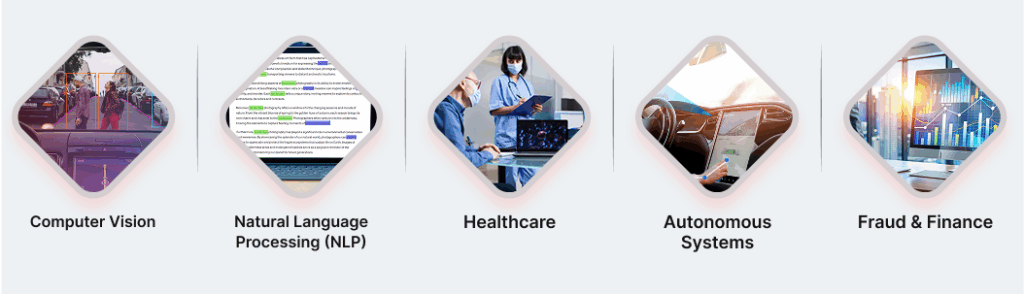
This methodology is applied across almost every sector that relies on machine learning.
Computer Vision
In computer vision, precision is key. Humans are used to draw bounding boxes around objects for autonomous vehicles or to tag products in retail inventory images. If a model confuses a pedestrian with a lamppost, a human validator corrects the tag, teaching the car the difference.
Natural Language Processing (NLP)
For text classification and sentiment analysis, context is everything. Sarcasm, slang, and cultural nuances often trip up AI. Humans review chat moderation logs or categorize customer support tickets to ensure the AI understands the intent behind the words.
Healthcare
HITL machine learning is vital in medical imaging. An AI might flag a potential tumor on an X-ray, but a radiologist reviews the finding to confirm the diagnosis. The doctor’s confirmation serves as the final say, ensuring patient safety while helping the model learn.
Autonomous Systems
Self-driving technology relies on reviewing edge cases. When a vehicle disengages from autopilot because of a construction zone, human reviewers analyze the sensor data to teach the system how to navigate those cones in the future.
Fraud & Finance
Financial institutions use AI to flag suspicious transactions. However, blocking a legitimate card transaction frustrates customers. Human analysts review flagged transactions to determine if they are actual fraud or just unusual spending behavior, refining the risk prediction model.
Human-in-the-Loop vs. Fully Automated AI
Understanding the trade-offs between these two approaches is essential for business leaders.
- Accuracy: Fully automated AI is often less accurate on complex tasks. HITL is highly accurate due to validation.
- Risk: Automated systems carry high risk in unpredictable scenarios. HITL minimizes risk through oversight.
- Scalability: Automation scales instantly but can scale errors. HITL requires managing a workforce but scales quality.
- Trustworthiness: Automated systems are “black boxes.” HITL systems build trust because outcomes are verified.
While automation offers speed, HITL machine learning offers reliability.
Challenges in Implementing HITL AI
Despite the benefits, bringing humans into the loop introduces its own set of challenges. Managing a large human workforce requires significant coordination. You must ensure annotation consistency—making sure five different reviewers would label the same image the exact same way.
Scaling these review processes can also become a bottleneck if not managed correctly. Companies often struggle with cost control and workflow design, trying to balance the speed of the machine with the cost of human time. This is why many organizations turn to structured annotation platforms and partners to manage the complexity.
How GetAnnotator Supports Human-in-the-Loop AI
For businesses looking to implement these workflows without the headache of managing internal teams, GetAnnotator serves as a strategic partner. GetAnnotator provides the infrastructure for high-quality data annotation and human review workflows.
By offering scalable teams of annotators and a robust platform, GetAnnotator helps companies build reliable HITL machine learning pipelines. Whether it’s validating computer vision models or cleaning up NLP datasets, they ensure the human feedback loop is efficient and accurate.
Future of Human-in-the-Loop AI
As AI models become more sophisticated, the role of the human will shift but not disappear. We are moving toward “hybrid intelligence,” where AI handles the bulk of the work, and humans focus on high-level judgment, ethics, and managing complex edge cases. The importance of human in the loop AI will only grow as we demand more trustworthy and ethical systems from our technology.
Conclusion
Human in the loop AI is not just a stepping stone to automation; it is a permanent requirement for building safe, accurate, and reliable systems. By integrating human judgment into the learning process, businesses can overcome the limitations of raw data and build models that actually work in the real world. With partners like GetAnnotator enabling these workflows, HITL machine learning is becoming the standard for enterprise AI success.
 Previous Blog
Related Blogs

June 8, 2026
Why You Should Outsource Document Annotation
The demand for document artificial intelligence is growing rapidly across almost every industry. Organizations are constantly looking for ways to extract valuable insights from the massive volume of unstructured data they generate daily. High-quality annotated documents are essential for training the machine learning models that make this possible. Without accurately labeled data, even the most […]
Read More

June 5, 2026
Keypoint Annotation Outsourcing Guide for AI Teams
Building highly accurate computer vision models requires massive volumes of flawlessly labeled data. Machine learning engineers and data scientists face mounting pressure to deliver complex datasets rapidly. As computer vision applications evolve to recognize intricate movements and spatial relationships, basic labeling techniques fall short. Keypoint annotation has emerged as a critical requirement for modern AI […]
Read More

June 3, 2026
Scaling AI? Why You Should Outsource Text Annotation Services
Training a robust natural language processing (NLP) model requires massive amounts of high-quality data. AI algorithms do not inherently understand human language. They learn through carefully labeled datasets. Accurate text annotation provides the foundational context that allows AI systems to interpret nuances, sentiment, and user intent. As the complexity of AI models grows, so does […]
Read More

May 27, 2026
Building AI? Why You Need Trusted Data Annotation Platforms
The demand for high-quality AI training data is growing rapidly. Organizations are launching increasingly complex machine learning models, and these systems require massive amounts of accurately labeled data. Annotation quality directly impacts how well an AI model performs in the real world. A poorly trained model will make mistakes, cost your business money, and damage […]
Read More