

How to Outsource AI Training Data Annotation Tasks Without the Headache
Machine learning models are only as smart as the data you feed them. It is the golden rule of AI development: garbage in, garbage out. While your team might have the best algorithms and the brightest data scientists, your project will stall without high-quality, accurately labeled data.
This is where the bottleneck usually happens. Your data scientists should be focusing on building models, not drawing bounding boxes around cars or tagging sentiment in customer reviews. To scale effectively, you need to look outside your internal team.
Outsourcing AI training data annotation tasks is the standard solution for growing companies, but it is not without its pitfalls. If done incorrectly, you risk data security breaches, poor quality control, and project delays. If done right, however, you unlock speed, scalability, and cost-efficiency that internal teams simply cannot match.
Here is your comprehensive guide to outsourcing data annotation effectively.
Why Outsourcing is the Smarter Move
Many startups initially try to handle annotation internally. Engineers spend their weekends labeling images, or interns are hired temporarily. This approach is rarely sustainable. Here is why shifting to a dedicated external team is usually the superior strategy.
1. Significant Cost Reductions
Hiring full-time employees for annotation is expensive. Between salaries, benefits, and equipment, the costs add up quickly. Traditional hiring can cost a company upwards of $7,000 to $10,000 per month when factoring in management overhead and recruitment costs.
In contrast, outsourcing services—specifically subscription-based models—can offer skilled annotators for a fraction of that price. For example, modern platforms offer dedicated skilled annotators starting around $499 per month. This allows you to allocate your budget toward R&D rather than overhead.
2. Speed and Scalability
Recruiting internal staff takes time—often 2 to 4 weeks to source, interview, and onboard a single candidate. In the race to market, you do not have a month to waste.
Outsourcing providers specialize in rapid deployment. The best partners can assign a dedicated team to your project within 24 hours. Furthermore, project demands fluctuate. You might need five annotators this month and twenty the next. Outsourcing allows you to scale up or down instantly without the legal and logistical nightmares of hiring and firing internal staff.
3. Access to Specialized Tools and Talent
Annotation is a skill. Whether it is LIDAR annotation for autonomous vehicles, medical imaging diagnosis, or nuanced sentiment analysis, you need experts. Professional outsourcing providers vet their talent rigorously (often hiring the top 1%), ensuring they understand the specific taxonomies and guidelines of your industry.
The Challenges of Outsourcing (and How to Avoid Them)
While the benefits are clear, outsourcing AI training data annotation tasks comes with risks. Being aware of these challenges is the first step to mitigating them.
Maintaining Data Quality
The most common fear is a drop in quality. If an external team misunderstands your guidelines, you could end up with thousands of useless labeled images.
- The Fix: Look for providers that guarantee accuracy benchmarks (ideally ~95% or higher) and include a dedicated project coordinator to oversee quality assurance (QA).
Communication Barriers
Misalignment happens when feedback loops are slow. If you find an error, but it takes three days to relay that feedback to the annotators, you have lost valuable time.
- The Fix: Choose a partner that offers real-time communication channels, such as Slack integration or a direct dashboard chat, ensuring you are always in sync with your dedicated annotator.
Data Security
You are often handing over proprietary or sensitive data. You cannot afford a leak.
- The Fix: Never work with a provider that is vague about security. Ensure they are GDPR and ISO compliant and have strict data handling protocols in place.
How to Choose the Right Annotation Partner
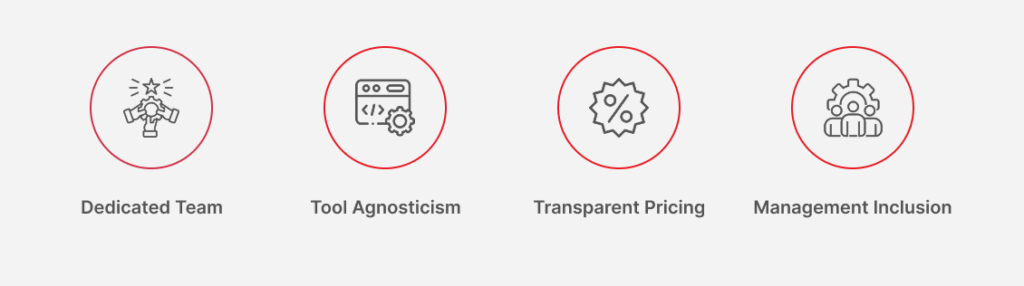
Not all annotation services are created equal. Some rely on anonymous crowdsourcing, where quality varies wildly, while others offer managed teams. Here are the criteria you should use to evaluate potential partners:
1. The “Dedicated Team” Model vs. Crowdsourcing
Avoid “black box” crowdsourcing where you don’t know who is touching your data. Look for a “human-in-the-loop” model where you are assigned a specific, dedicated annotator. This ensures consistency because the same person learns your specific guidelines and improves over time.
2. Tool Agnosticism
You shouldn’t be forced to change your tech stack to suit a vendor. The ideal partner should be able to work within your preferred tools, whether that is CVAT, Labelbox, AWS SageMaker, or a proprietary internal tool.
3. Transparent Pricing
Hidden fees are a plague in the outsourcing industry. Look for simple, flat-rate subscription models. You should know exactly what you are paying per month for a set number of hours or tasks, with no surprises.
4. Management Inclusion
Does the price include a project manager? If you have to manage the outsourced annotators yourself, you aren’t really saving time. Ensure the service includes a project coordinator who handles the day-to-day scheduling and QA.
Best Practices for a Smooth Workflow
Once you have selected a partner, follow these best practices to ensure your AI training data annotation tasks are completed flawlessly.
Create Clear Guidelines
Ambiguity is the enemy of accuracy. Provide a comprehensive “Gold Standard” set of examples showing exactly what constitutes a correct label and what does not. If you are annotating pedestrians, does a person riding a bicycle count? Your guidelines must answer these edge cases.
Start with a Pilot
Don’t dump 100,000 images on a new team on day one. Start with a small batch. Review the output, refine the guidelines based on the results, and then scale up.
Establish Regular Checkpoints
Don’t wait until the end of the month to review the work. Implement daily or weekly review checkpoints. A managed service provider should offer a dashboard where you can track progress and quality metrics in real-time.
The Path to Better Data
Outsourcing your data annotation is not just about saving money; it is about freeing your internal team to focus on innovation. By moving the heavy lifting of labeling to a dedicated, professional team, you remove the biggest bottleneck in your AI development pipeline.
When you are ready to scale, look for a partner that combines the flexibility of a subscription with the quality of an in-house team. With the right approach, you can turn data annotation from a burden into your competitive advantage.
 Previous Blog
Related Blogs

June 8, 2026
Why You Should Outsource Document Annotation
The demand for document artificial intelligence is growing rapidly across almost every industry. Organizations are constantly looking for ways to extract valuable insights from the massive volume of unstructured data they generate daily. High-quality annotated documents are essential for training the machine learning models that make this possible. Without accurately labeled data, even the most […]
Read More

June 5, 2026
Keypoint Annotation Outsourcing Guide for AI Teams
Building highly accurate computer vision models requires massive volumes of flawlessly labeled data. Machine learning engineers and data scientists face mounting pressure to deliver complex datasets rapidly. As computer vision applications evolve to recognize intricate movements and spatial relationships, basic labeling techniques fall short. Keypoint annotation has emerged as a critical requirement for modern AI […]
Read More

June 3, 2026
Scaling AI? Why You Should Outsource Text Annotation Services
Training a robust natural language processing (NLP) model requires massive amounts of high-quality data. AI algorithms do not inherently understand human language. They learn through carefully labeled datasets. Accurate text annotation provides the foundational context that allows AI systems to interpret nuances, sentiment, and user intent. As the complexity of AI models grows, so does […]
Read More

May 27, 2026
Building AI? Why You Need Trusted Data Annotation Platforms
The demand for high-quality AI training data is growing rapidly. Organizations are launching increasingly complex machine learning models, and these systems require massive amounts of accurately labeled data. Annotation quality directly impacts how well an AI model performs in the real world. A poorly trained model will make mistakes, cost your business money, and damage […]
Read More