
- What Do Freelance Data Annotators Do?
- Why Companies Prefer Freelance Data Annotators
- Key Skills to Look for in Freelance Data Annotators
- Challenges of Hiring Freelance Data Annotators
- How to Successfully Hire Freelance Data Annotators
- Freelancers vs Dedicated Annotation Companies
- Best Practices for Managing Freelance Annotation Teams
- The Future of Freelance Data Annotation
- Building Reliable AI Datasets with the Right Talent
- FAQs
Freelance Data Annotators for Hire: Finding AI Experts
Artificial intelligence is only as good as the data it learns from. As the demand for AI models grows across every industry, the need for high-quality training data has skyrocketed right alongside it. Machine learning algorithms require massive amounts of accurately labeled information to function properly, driving businesses to seek out skilled professionals who can turn raw data into structured insights.
Searching for freelance data annotators for hire has become a common strategy for companies building AI. These independent contractors offer a flexible, cost-effective way to scale data labeling efforts without the overhead of full-time employees. Whether an organization is training a computer vision model for self-driving cars or a natural language processing tool for customer service, the success of the project hinges entirely on the quality of the underlying annotations.
This post will explore exactly what freelance annotators do, why businesses prefer them for certain projects, and how you can successfully hire and manage top-tier labeling experts to build reliable AI datasets.
What Do Freelance Data Annotators Do?
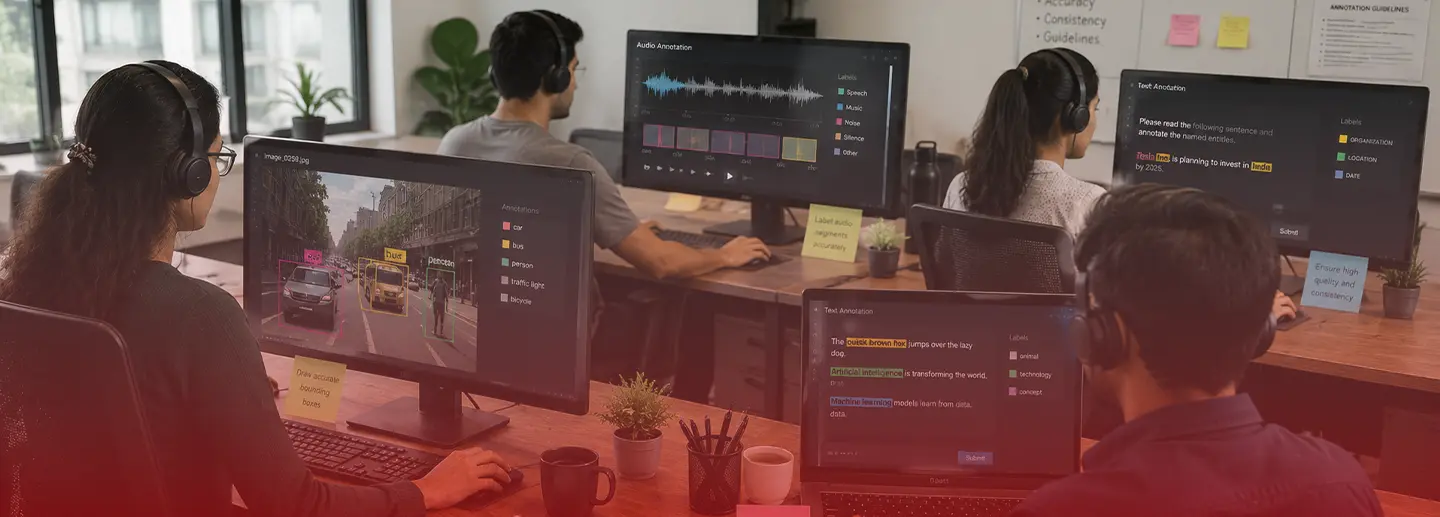
Freelance data annotators take raw data—like images, text, and audio—and add tags or labels that help machine learning models understand it. They provide the human context that computers lack.
Core Responsibilities
Annotators handle a wide variety of data types depending on the project. Image annotation might involve drawing bounding boxes around vehicles, while video labeling requires tracking objects frame-by-frame. Text annotation includes highlighting specific entities or determining sentiment. Audio transcription and tagging are essential for voice recognition software. Across all these formats, annotators use techniques like segmentation, classification, and keypoint annotation to structure the data perfectly.
Industries That Hire Freelance Annotators
Almost every sector investing in AI relies on data annotation. Autonomous vehicle companies need annotators to label street signs and pedestrians. Healthcare AI relies on specialists to highlight tumors in medical imaging. Retail and ecommerce brands use them to categorize product catalogs. You will also find annotators shaping datasets for robotics, finance and document processing, and even agriculture through drone analytics.
Why Companies Prefer Freelance Data Annotators
Organizations are shifting away from rigid hiring structures, finding that independent contractors offer unique benefits for machine learning projects.
Cost-Effective Scaling
Working with freelancers allows businesses to build a flexible workforce without the heavy costs associated with full-time hiring, such as benefits and office space. This makes scaling up for large annotation projects incredibly easy and budget-friendly.
Access to Specialized Skills
Sometimes a project requires specific domain knowledge. By searching globally, companies can find domain-specific annotators for complex medical, legal, or robotics datasets. This global talent pool also provides multilingual annotation capabilities essential for global AI products.
Faster Project Turnaround
A distributed workforce offers distinct speed advantages. By hiring freelancers across different time zones, companies can achieve 24/7 productivity, ensuring that datasets are completed rapidly.
Ideal for Short-Term AI Projects
Not every AI initiative requires a permanent team. Freelancers are the perfect fit for pilot AI models, proof-of-concept datasets, and seasonal annotation requirements that will eventually taper off.
Key Skills to Look for in Freelance Data Annotators
When evaluating candidates, certain skills separate average annotators from exceptional ones.
Technical Annotation Expertise
Candidates must have experience with industry-standard annotation tools. Furthermore, they need a solid understanding of AI and ML data requirements to know how their work impacts the final algorithm.
Attention to Detail
High-quality AI requires extreme accuracy and consistency. The best annotators excel at handling tricky edge cases where the labeling guidelines might seem ambiguous.
Domain Knowledge
For specialized projects, industry-specific understanding is non-negotiable. Context-aware labeling ensures that a legal contract or a medical scan is interpreted correctly by the annotator before the AI ever sees it.
Communication & Workflow Management
Remote work demands excellent communication. Annotators must demonstrate the ability to follow strict guidelines and collaborate seamlessly with QA teams and AI engineers to resolve questions quickly.
Challenges of Hiring Freelance Data Annotators
While the benefits are clear, managing an independent workforce comes with distinct hurdles.
Inconsistent Annotation Quality
Relying on multiple independent workers increases human error risks. A lack of standardized workflows across different freelancers can lead to messy, inconsistent datasets.
Data Security Concerns
Handling sensitive datasets outside a secure corporate network is risky. Managing NDAs and ensuring compliance with data privacy regulations is much harder when working with distributed freelancers.
Project Management Complexity
Coordinating dozens of multiple freelancers is a logistical challenge. Tracking individual productivity, managing payouts, and monitoring accuracy requires dedicated oversight.
Training & Onboarding Time
Every project has a unique annotation guideline learning curve. Getting a freelancer familiar with your specific tool and edge-case rules takes valuable time away from actual labeling.
How to Successfully Hire Freelance Data Annotators
To mitigate these challenges, companies need a structured approach to sourcing and onboarding talent.
Define Clear Annotation Requirements
Before you look for freelance data annotators for hire, know exactly what you need. Define the specific data type, the required annotation format, and the quality benchmarks you expect them to hit.
Conduct Annotation Test Tasks
Never hire based on a resume alone. Implement small, paid trial projects to run an accuracy evaluation. This quickly reveals who actually understands your instructions.
Use Standardized Guidelines
Provide incredibly detailed instructions. Include visual examples of correct and incorrect labels, and create a specific section dedicated to edge-case handling so freelancers know exactly what to do when they are unsure.
Implement Quality Assurance
Do not assume the first pass is perfect. Build multi-level review systems, utilize consensus validation (having multiple people annotate the same file), and conduct random audits to maintain high standards.
Choose the Right Annotation Platform
Use specialized software that features strong collaboration tools, workforce management capabilities, and built-in quality monitoring features to keep everyone aligned.
Freelancers vs Dedicated Annotation Companies
When deciding how to label your data, you generally have two main choices.
Freelance Annotators
- Lower cost
- Flexible hiring
- Suitable for small projects
- Easier short-term hiring
Dedicated Annotation Companies
- Higher scalability
- Structured QA process
- Better for enterprise datasets
- Stronger data security
Which Option is Better?
Freelancers are the right fit for startups, proof-of-concept models, and teams with strong internal project management. Managed annotation services make more sense for massive enterprise datasets, highly secure data (like patient records), and companies lacking internal QA resources.
Best Practices for Managing Freelance Annotation Teams
Once you have your team in place, effective management will determine the success of your dataset.
Create Clear Documentation
Maintain living annotation SOPs (Standard Operating Procedures). Regularly update your labeling examples as new edge cases are discovered during the project.
Monitor Quality Metrics
Track performance rigorously. Keep an eye on individual accuracy scores, inter-annotator agreement rates, and overall error tracking to catch recurring issues early.
Maintain Continuous Feedback
Host weekly reviews with your team. Providing real-time corrections helps annotators adjust their techniques before they label thousands of additional files incorrectly.
Build Long-Term Relationships
Constantly onboarding new workers drains resources. Focus on retaining skilled annotators by treating them well and communicating clearly, which naturally improves consistency over time.
The Future of Freelance Data Annotation
Data labeling is evolving rapidly, creating new opportunities for highly skilled freelancers.
Growing Demand for Human-in-the-Loop AI
Even as automated labeling improves, AI still requires human validation. The rise of complex, multimodal datasets means that human judgment will remain a critical part of the AI pipeline for years to come.
Specialized Annotation Opportunities
Basic bounding boxes are becoming automated. The future of freelance annotation lies in complex fields such as robotics, healthcare imaging, 3D point-cloud annotation, and generative AI alignment data.
AI-Assisted Annotation Workflows
Freelancers will increasingly engage in human and AI collaboration. Semi-automated annotation systems will pre-label data, leaving the human expert to review, correct, and refine the AI’s initial guess.
Building Reliable AI Datasets with the Right Talent

Hiring skilled freelance data annotators is a strategic move for businesses looking to build intelligent, accurate AI models. It requires striking the perfect balance between scalability, overall cost, and data quality. By putting strong workflows, crystal-clear guidelines, and rigorous QA systems in place, your business can leverage global talent to build flawless datasets. Securing the right annotation experts ensures your machine learning algorithms have the reliable foundation they need to succeed.
FAQs
Ans: – They are independent contractors who label, tag, or structure raw data (like text, images, or video) to train machine learning algorithms.
Ans: – You can find them on general freelance marketplaces like Upwork and Fiverr, or through specialized AI data platforms like GetAnnotator, which connect businesses with vetted labeling experts.
Ans: – Costs vary widely based on location, domain expertise, and data complexity. Basic image tagging may cost a few dollars an hour, while specialized medical annotation can cost significantly more.
Ans: – They need extreme attention to detail, proficiency with annotation software, strong communication skills, and for some projects, specific industry knowledge.
Ans: – They can be, provided the enterprise has a robust internal project management team and strict QA processes to coordinate the distributed workforce.
Ans: – Companies ensure quality through detailed guidelines, paid test tasks, multi-level review processes, and continuous feedback loops.
Ans: – Yes, but companies must seek out freelancers with specific domain expertise and ensure strict data security and NDA compliance protocols are followed.
Ans: – Top industries include autonomous vehicles, healthcare, retail, agriculture, robotics, and finance.
 Previous Blog
Related Blogs

June 8, 2026
Why You Should Outsource Document Annotation
The demand for document artificial intelligence is growing rapidly across almost every industry. Organizations are constantly looking for ways to extract valuable insights from the massive volume of unstructured data they generate daily. High-quality annotated documents are essential for training the machine learning models that make this possible. Without accurately labeled data, even the most […]
Read More

June 5, 2026
Keypoint Annotation Outsourcing Guide for AI Teams
Building highly accurate computer vision models requires massive volumes of flawlessly labeled data. Machine learning engineers and data scientists face mounting pressure to deliver complex datasets rapidly. As computer vision applications evolve to recognize intricate movements and spatial relationships, basic labeling techniques fall short. Keypoint annotation has emerged as a critical requirement for modern AI […]
Read More
June 3, 2026
Scaling AI? Why You Should Outsource Text Annotation Services
Training a robust natural language processing (NLP) model requires massive amounts of high-quality data. AI algorithms do not inherently understand human language. They learn through carefully labeled datasets. Accurate text annotation provides the foundational context that allows AI systems to interpret nuances, sentiment, and user intent. As the complexity of AI models grows, so does […]
Read More

May 27, 2026
Building AI? Why You Need Trusted Data Annotation Platforms
The demand for high-quality AI training data is growing rapidly. Organizations are launching increasingly complex machine learning models, and these systems require massive amounts of accurately labeled data. Annotation quality directly impacts how well an AI model performs in the real world. A poorly trained model will make mistakes, cost your business money, and damage […]
Read More