

- What Is a Multimodal Data Labeling Workforce?
- Why Multimodal AI Requires Specialized Annotation Teams
- Core Components of an Effective Multimodal Data Labeling Workforce
- Challenges in Managing a Multimodal Data Labeling Workforce
- Industries Driving Demand for Multimodal Annotation Workforces
- Best Practices for Building a High-Performing Multimodal Data Labeling Workforce
- The Role of AI-Assisted Annotation in Workforce Optimization
- Why Businesses Are Investing in Dedicated Multimodal Annotation Teams
- How GetAnnotator Supports Multimodal Data Labeling Workflows
- Preparing Your AI for the Real World
- FAQs
Multimodal Data Labeling Workforce: The Foundation of Advanced AI Training
Artificial intelligence is rapidly evolving past single data formats. A few years ago, an AI model might have only analyzed text or recognized images. Now, cutting-edge systems process the world much like humans do—combining sight, sound, and language to make complex decisions.
This shift has given rise to multimodal AI systems that simultaneously digest image, video, audio, LiDAR, text, sensor, and conversational data. These sophisticated models hold immense potential, from powering self-driving cars to diagnosing complex medical conditions. However, training these models requires massive amounts of accurately labeled data across multiple formats.
High-quality annotation now depends on specialized human teams capable of interpreting overlapping data streams. A multimodal data labeling workforce bridges the gap between raw data and intelligent algorithms. As projects grow in scope, managing these diverse teams becomes a significant logistical challenge.
Scalable annotation platforms like GetAnnotator provide the infrastructure needed to manage complex workforce operations seamlessly. By keeping tools, workflows, and quality assurance in one place, they ensure these specialized teams can operate at peak efficiency.
What Is a Multimodal Data Labeling Workforce?
A multimodal data labeling workforce is a structured team of human annotators, quality assurance specialists, and project managers dedicated to classifying overlapping data types.
Unlike traditional annotation teams that focus on a single medium—like tagging photos of cats—multimodal teams manage intricate, interconnected datasets. They handle a diverse array of data, including:
- Images
- Videos
- Audio
- Text
- 3D point clouds
- Sensor fusion data
- Multilingual conversational data
Real-world examples of this work are everywhere. In autonomous vehicles, teams label street signs, radar data, and 3D LiDAR scans simultaneously. Healthcare AI relies on annotators mapping clinical text to medical imaging. Robotics, retail analytics, smart surveillance, and generative AI systems all depend on this multi-layered approach to understand context and environment.
Why Multimodal AI Requires Specialized Annotation Teams
Single annotators often cannot handle multiple data formats effectively. The mental shift required to jump from transcribing audio to identifying spatial coordinates in a 3D point cloud is significant. Different modalities require entirely different areas of expertise.
| Data Type | Workforce Skill Needed |
| Video Annotation | Temporal tracking expertise |
| Audio Labeling | Linguistic and acoustic understanding |
| LiDAR Annotation | 3D spatial awareness |
| NLP Annotation | Language and domain expertise |
| Sensor Fusion | Cross-modal validation skills |
AI model training has experienced increased complexity. Developing reliable models requires synchronized labeling across all these modalities. If an autonomous vehicle’s camera data does not align perfectly with its LiDAR data, the AI could make catastrophic errors. Consistency and rigorous quality control are absolutely essential.
Core Components of an Effective Multimodal Data Labeling Workforce
Building an operation capable of feeding advanced AI models requires a strategic approach to human resources and tooling.
Skilled Human Annotators
You need a domain-trained workforce with industry specialization. A medical AI project requires annotators with healthcare backgrounds, just as global NLP models require language-specific teams.
Workforce Scalability
Data needs fluctuate. Organizations must have the ability to ramp teams quickly, handling enterprise-scale datasets without losing momentum. Effective distributed workforce management ensures projects stay on track across different time zones.
Quality Assurance Layers
Accurate AI requires strict oversight. Multi-review systems, consensus validation, and gold-standard benchmarking guarantee that labels remain precise across millions of data points.
Project Managers & QA Leads
Managers handle workflow coordination, productivity monitoring, and escalation handling. They act as the glue keeping distributed annotators aligned with project goals.
Annotation Platform Infrastructure
Collaborative tooling, workflow automation, and real-time progress tracking bring everything together. GetAnnotator supports workforce collaboration and project scalability, giving managers the visibility needed to guide complex operations.
Challenges in Managing a Multimodal Data Labeling Workforce
Scaling these operations introduces a unique set of hurdles.
Cross-Modal Consistency
Maintaining alignment between video, audio, and text labels is difficult. An error in one modality can corrupt the holistic understanding of the AI model.
Workforce Training Complexity
Different training requirements for different modalities slow down onboarding. Teaching someone to label bounding boxes takes hours; teaching them sensor fusion validation takes weeks.
Annotation Fatigue
Long-form video and audio projects demand high concentration. Over time, this focus wanes, reducing overall efficiency and accuracy.
Quality Drift at Scale
Maintaining annotation standards across large, distributed teams requires constant vigilance. Without proper systems, individual interpretations can skew the dataset.
Tool Fragmentation
Using multiple disconnected tools slows workflows and frustrates annotators. Centralized annotation platforms improve operational efficiency by keeping all modalities, guidelines, and QA tools under one roof.
Industries Driving Demand for Multimodal Annotation Workforces
Several major sectors rely heavily on diverse data annotation to push technological boundaries.
Autonomous Vehicles
Self-driving technology requires synchronized camera, LiDAR, and radar annotation to safely navigate roads.
Robotics & Embodied AI
Teaching machines to interact with physical spaces involves human motion tracking, egocentric video labeling, and sensor synchronization.
Healthcare AI
Modern diagnostic tools combine medical imaging, voice notes, and clinical text annotation to provide comprehensive patient insights.
Retail & Smart Surveillance
Stores optimize layouts and security through customer activity tracking, video analytics, and behavioral annotation.
Conversational AI
Virtual assistants need audio transcription, intent labeling, and emotion recognition to interact naturally with human users.
Best Practices for Building a High-Performing Multimodal Data Labeling Workforce
Success in data annotation depends on process optimization and clear communication.
Standardized Annotation Guidelines
Provide clear standard operating procedures (SOPs) and comprehensive edge-case handling documentation. Annotators should never have to guess how to label an anomaly.
Modality-Specific Training
Implement specialized onboarding programs. Tailor the training entirely to the specific data format the annotator will handle.
Continuous QA Monitoring
Regularly evaluate performance using accuracy scoring, random audits, and constant feedback loops.
Workforce Segmentation
Assign tasks based on expertise. Keep linguistic experts on text and audio, and spatial experts on LiDAR and video.
Scalable Annotation Infrastructure
Leverage cloud-based collaboration and integrated workflow management. Platforms like GetAnnotator help businesses manage large annotation teams efficiently by streamlining communication and task distribution.
The Role of AI-Assisted Annotation in Workforce Optimization
Automation is changing how human teams operate. Through human-in-the-loop annotation, pre-labeling automation, and model-assisted workflows, teams experience significantly faster turnaround times.
However, AI-assisted labeling still requires skilled human validation. Algorithms can draft the initial bounding boxes or transcriptions, but humans must verify the edge cases and correct subtle errors that machines miss.
Why Businesses Are Investing in Dedicated Multimodal Annotation Teams
Enterprises are prioritizing dedicated labeling teams to secure a competitive advantage. Clean, accurate data leads to faster AI deployment and better model accuracy. It reduces training bias and vastly improves edge-case handling.
Ultimately, data quality directly impacts AI performance. Scalability for enterprise AI systems is impossible without a reliable, specialized workforce fueling the algorithms.
How GetAnnotator Supports Multimodal Data Labeling Workflows
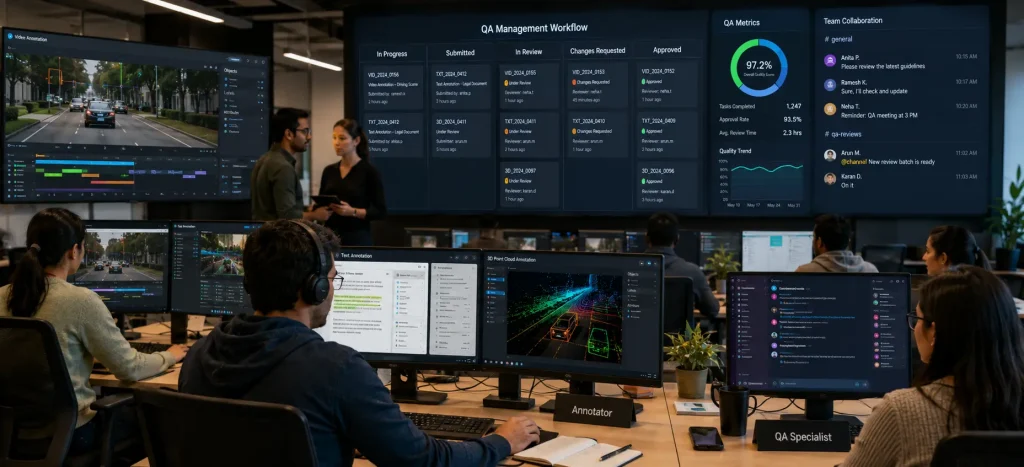
Managing complex data formats requires purpose-built infrastructure. GetAnnotator offers robust platform capabilities designed for modern AI development.
With multi-format annotation support, teams can process video, text, and 3D data in a single environment. The platform includes powerful workforce collaboration tools and comprehensive QA management workflows. Users benefit from scalable project handling, custom workflow configuration, and enterprise-ready annotation infrastructure.
Looking to scale your multimodal data labeling workforce? GetAnnotator helps teams manage complex AI annotation workflows with speed, quality, and collaboration.
Preparing Your AI for the Real World
Multimodal AI is increasing annotation complexity across every major industry. As models become more sophisticated, skilled annotation workforces are critical for AI success. Scalability, quality assurance, and workflow coordination are the pillars of a strong data pipeline. Centralized platforms help enterprises manage modern annotation operations efficiently, ensuring models perform accurately in the real world.
FAQs
Ans: – It is a specialized team of annotators, QA leads, and managers trained to label diverse, overlapping data formats like video, audio, text, and LiDAR simultaneously.
Ans: – Modern AI models need to process multiple data streams to understand real-world contexts accurately, requiring synchronized and precisely labeled data across all formats.
Ans: – Key industries include autonomous vehicles, healthcare AI, robotics, retail surveillance, and conversational AI development.
Ans: – Common challenges include maintaining cross-modal consistency, handling complex training requirements, fighting annotation fatigue, and preventing quality drift at scale.
Ans: – Model-assisted workflows use pre-labeling automation to handle initial annotations, allowing human workers to focus on faster validation and edge-case correction.
Ans: – Platforms should feature multi-format support, collaborative tooling, automated QA workflows, and scalable project management infrastructure.
Ans: – GetAnnotator provides centralized, enterprise-ready infrastructure featuring multi-format support, robust QA tools, and workflow automation to manage large, complex annotation teams effectively.
 Previous Blog
Related Blogs

June 8, 2026
Why You Should Outsource Document Annotation
The demand for document artificial intelligence is growing rapidly across almost every industry. Organizations are constantly looking for ways to extract valuable insights from the massive volume of unstructured data they generate daily. High-quality annotated documents are essential for training the machine learning models that make this possible. Without accurately labeled data, even the most […]
Read More

June 5, 2026
Keypoint Annotation Outsourcing Guide for AI Teams
Building highly accurate computer vision models requires massive volumes of flawlessly labeled data. Machine learning engineers and data scientists face mounting pressure to deliver complex datasets rapidly. As computer vision applications evolve to recognize intricate movements and spatial relationships, basic labeling techniques fall short. Keypoint annotation has emerged as a critical requirement for modern AI […]
Read More

June 3, 2026
Scaling AI? Why You Should Outsource Text Annotation Services
Training a robust natural language processing (NLP) model requires massive amounts of high-quality data. AI algorithms do not inherently understand human language. They learn through carefully labeled datasets. Accurate text annotation provides the foundational context that allows AI systems to interpret nuances, sentiment, and user intent. As the complexity of AI models grows, so does […]
Read More

May 27, 2026
Building AI? Why You Need Trusted Data Annotation Platforms
The demand for high-quality AI training data is growing rapidly. Organizations are launching increasingly complex machine learning models, and these systems require massive amounts of accurately labeled data. Annotation quality directly impacts how well an AI model performs in the real world. A poorly trained model will make mistakes, cost your business money, and damage […]
Read More