

- What Is Inter-Annotator Agreement?
- Why Inter-Annotator Agreement Is Important for AI Training
- How Inter-Annotator Agreement Works in Annotation Workflows
- Common Metrics Used to Measure Inter-Annotator Agreement
- Factors That Affect Inter-Annotator Agreement
- Acceptable Inter-Annotator Agreement Scores
- Best Practices to Improve Inter-Annotator Agreement
- Role of Professional Annotation Teams in Maintaining High Agreement
- How GetAnnotator Ensures High Inter-Annotator Agreement
- Real-World Applications of Inter-Annotator Agreement
- Challenges in Measuring Inter-Annotator Agreement
- Future of Quality Control in Data Annotation
- Building Reliable Datasets for the Future of AI
What Is Inter-Annotator Agreement in Data Annotation?
Artificial intelligence and machine learning models rely entirely on high-quality labeled data to make accurate predictions. When a model looks at an image, reads a text, or processes an audio clip, it uses human-provided annotations as the ground truth.
However, building these datasets introduces a major challenge. Different annotators often interpret the exact same piece of data in completely different ways. One person might label a customer review as “frustrated,” while another labels it “neutral.” If your training data is full of these inconsistencies, your machine learning model will struggle to learn effectively.
This brings us to a critical concept in data labeling: inter annotator agreement. Companies building AI products must carefully monitor annotation consistency to ensure their models function correctly. This applies across all types of machine learning projects, from computer vision datasets and NLP datasets to complex speech recognition systems.
Inter annotator agreement serves as an essential quality control metric, helping teams spot errors early and keep their data pipelines running smoothly.
What Is Inter-Annotator Agreement?
Inter annotator agreement (IAA) measures the level of consistency between multiple annotators labeling the exact same dataset. It acts as a mathematical indicator of how reliable and uniform your human labels actually are.
Consider a simple sentiment analysis project. Three different people read the sentence: “The new update is okay, but it took way too long to install.”
- Annotator 1 labels the sentence as Positive.
- Annotator 2 labels it as Neutral.
- Annotator 3 labels it as Positive.
Because there is disagreement, the overall agreement score for this data point drops. A high agreement score indicates that human labelers consistently arrive at the same conclusion, meaning the labels are reliable enough for a machine to learn from.
Human judgment naturally varies. This variance usually stems from ambiguous data, inconsistent annotation guidelines, a lack of adequate training, or high domain complexity. Ultimately, a high inter annotator agreement equals a reliable, consistent, and highly useful dataset.
Why Inter-Annotator Agreement Is Important for AI Training
Achieving high agreement among your labeling team provides several direct benefits to your machine learning initiatives.
1. Improves Dataset Reliability
Consistently high agreement scores ensure your labels are accurate and uniform. This gives data scientists confidence that the ground truth feeding their models is solid.
2. Reduces Model Bias
Disagreements can introduce label noise and unintentional bias. When multiple reviewers align on a label, it smooths out individual subjective biases.
3. Improves Model Performance
Better data leads directly to better predictions. Models trained on consistent labels converge faster and perform more reliably in production environments.
4. Helps Identify Ambiguous Data
A sudden drop in agreement often signals a problem with the data itself. Low agreement usually points to unclear instructions or edge cases that the current guidelines fail to address.
5. Enables Continuous Quality Control
Companies monitor IAA continuously to maintain strict annotation standards over the lifespan of a long-term project.
How Inter-Annotator Agreement Works in Annotation Workflows
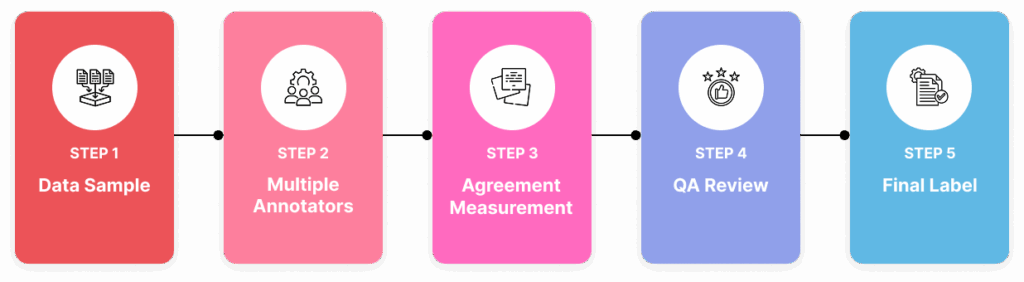
Professional data annotation pipelines use specific workflows to track and maintain agreement. First, the dataset is distributed to multiple annotators. Each annotator independently labels the exact same sample set.
Once the labeling is complete, the system compares the outputs and calculates an agreement score. Disagreements are then flagged and reviewed by quality assurance (QA) experts.
A standard workflow looks like this:
Data Sample → Multiple Annotators → Agreement Measurement → QA Review → Final Label
This overlap process helps maintain incredibly high-quality training datasets, catching errors before they ever reach the engineering team.
Common Metrics Used to Measure Inter-Annotator Agreement
Data scientists rely on several statistical methods to measure how often annotators agree.
Cohen’s Kappa
This metric measures agreement between exactly two annotators. It is highly valued because it adjusts for the probability that the annotators might have agreed simply by chance.
Fleiss’ Kappa
When you have more than two annotators labeling the same data, Fleiss’ Kappa is the standard metric. It accommodates a larger pool of reviewers assessing the same items.
Krippendorff’s Alpha
This is a highly flexible metric. It works with multiple annotators, can handle missing values, and functions across different data types (nominal, ordinal, interval).
Percentage Agreement
The absolute simplest metric available. It calculates the raw percentage of times annotators agree on a label. While easy to understand, it fails to account for chance agreement.
Metric Comparison
- Percentage Agreement: Best for quick checks. Low complexity.
- Cohen’s Kappa: Best for two annotators. Medium complexity.
- Fleiss’ Kappa: Best for multiple annotators. High complexity.
- Krippendorff’s Alpha: Best for incomplete data and multiple annotators. High complexity.
Factors That Affect Inter-Annotator Agreement
Several variables dictate how closely your annotators will align.
1. Annotation Guidelines
Poor, vague, or incomplete instructions lead directly to inconsistent labels. Clear guidelines are the foundation of high agreement.
2. Annotator Training
Experienced annotators who understand the specific domain produce significantly higher agreement scores than untrained workers.
3. Dataset Complexity
Projects involving medical imaging or legal document review naturally have lower initial agreement due to the specialized knowledge required to interpret the data.
4. Ambiguous Data
Certain data types are inherently difficult to classify. Sarcasm in NLP projects or heavily occluded objects in images will always generate more disagreement.
5. Annotation Tools
Better software platforms improve efficiency and accuracy, providing features like data validation that prevent simple human errors.
Acceptable Inter-Annotator Agreement Scores
While acceptable levels vary heavily depending on the specific task and industry, most data science teams follow a general benchmark:
- 0.80+: Excellent agreement. The data is highly reliable.
- 0.60 – 0.79: Moderate agreement. The data is usable, but guidelines may need refining.
- 0.40 – 0.59: Weak agreement. The labels require significant QA review.
- Below 0.40: Poor agreement. The annotation process must be halted and restructured.
Best Practices to Improve Inter-Annotator Agreement
1. Create Detailed Annotation Guidelines
Always document edge cases. Include extensive visual or textual examples of what to do when data falls into gray areas.
2. Train Annotators Thoroughly
Implement rigorous onboarding programs. Require annotators to pass test tasks before they touch production data.
3. Use Pilot Annotation Phases
Start by labeling a very small dataset. Measure the agreement, find the pain points, and refine your guidelines before scaling up the workforce.
4. Implement Multi-Layer QA
Use peer review systems alongside expert validation to catch disagreements early.
5. Provide Feedback Loops
Conduct regular performance reviews with your labeling team so they can learn from past disagreements.
Role of Professional Annotation Teams in Maintaining High Agreement
Dedicated annotation teams consistently outperform random crowdsourced freelancers. Professional providers offer highly trained annotators, standardized workflows, and rigorous quality monitoring.
Because they track agreement across thousands of tasks, professional teams can quickly spot when a project is going off the rails. This level of oversight helps enterprise companies achieve the consistent labels and reliable training datasets they need to deploy accurate AI models.
How GetAnnotator Ensures High Inter-Annotator Agreement
Achieving top-tier consistency requires infrastructure and expertise. GetAnnotator utilizes dedicated annotation teams and domain-trained experts to handle complex datasets.
By implementing multi-level quality checks and helping clients build structured annotation guidelines, GetAnnotator maintains continuous agreement monitoring. This scalable annotation workforce ensures that inter annotator agreement remains exceptionally high, no matter the size or scope of the project.
Real-World Applications of Inter-Annotator Agreement
Different branches of AI rely on agreement metrics to function safely and accurately.
Natural Language Processing
Agreement is heavily monitored during sentiment analysis and named entity recognition to ensure chatbots and search engines understand human intent.
Computer Vision
Tasks like bounding box object detection and pixel-perfect image segmentation require strict agreement to ensure machines can “see” the world correctly.
Speech AI
Audio transcription and speaker labeling projects use IAA to ensure accents, background noise, and overlapping speech are handled uniformly.
Autonomous Vehicles
Lane detection and pedestrian classification literally depend on perfect consensus. Low agreement in autonomous driving datasets can lead to catastrophic physical failures.
Challenges in Measuring Inter-Annotator Agreement
Measuring agreement is not always easy. Subjectivity in labels makes certain tasks incredibly frustrating to score. Complex data types, like 3D point clouds, require massive effort just to compare two different annotations.
Furthermore, scaling annotation teams while maintaining high agreement requires significant management overhead. Finally, the cost of double annotation—having two people do the same work just to check for agreement—can strain project budgets. Structured annotation workflows are strictly necessary to balance these costs against the need for quality.
Future of Quality Control in Data Annotation
The data labeling industry is rapidly evolving. Emerging trends include AI-assisted annotation, where models take a first pass at labeling, and human annotators correct the mistakes.
Smart disagreement detection systems and active learning pipelines are automating the quality scoring process. Even as tools become more automated, human-in-the-loop systems will continually rely on robust agreement metrics to ensure the AI isn’t simply learning from its own mistakes.
Building Reliable Datasets for the Future of AI
Inter annotator agreement is absolutely essential for dataset reliability. It ensures consistent, high-quality annotations while preventing bias and label noise from degrading machine learning models.
Monitoring agreement on a continuous basis helps improve overall model accuracy and highlights areas where project guidelines fall short. Working with experienced annotation teams ensures scalable and highly reliable labeling workflows from day one.
Companies building advanced AI systems should prioritize quality-driven annotation processes and strong agreement metrics to guarantee their models perform flawlessly in the real world.
 Previous Blog
Related Blogs

June 8, 2026
Why You Should Outsource Document Annotation
The demand for document artificial intelligence is growing rapidly across almost every industry. Organizations are constantly looking for ways to extract valuable insights from the massive volume of unstructured data they generate daily. High-quality annotated documents are essential for training the machine learning models that make this possible. Without accurately labeled data, even the most […]
Read More

June 5, 2026
Keypoint Annotation Outsourcing Guide for AI Teams
Building highly accurate computer vision models requires massive volumes of flawlessly labeled data. Machine learning engineers and data scientists face mounting pressure to deliver complex datasets rapidly. As computer vision applications evolve to recognize intricate movements and spatial relationships, basic labeling techniques fall short. Keypoint annotation has emerged as a critical requirement for modern AI […]
Read More

June 3, 2026
Scaling AI? Why You Should Outsource Text Annotation Services
Training a robust natural language processing (NLP) model requires massive amounts of high-quality data. AI algorithms do not inherently understand human language. They learn through carefully labeled datasets. Accurate text annotation provides the foundational context that allows AI systems to interpret nuances, sentiment, and user intent. As the complexity of AI models grows, so does […]
Read More

May 27, 2026
Building AI? Why You Need Trusted Data Annotation Platforms
The demand for high-quality AI training data is growing rapidly. Organizations are launching increasingly complex machine learning models, and these systems require massive amounts of accurately labeled data. Annotation quality directly impacts how well an AI model performs in the real world. A poorly trained model will make mistakes, cost your business money, and damage […]
Read More