

- What Is Data Annotation?
- Understanding In-House Data Annotation
- Pros of In-House Annotation
- Cons of In-House Annotation
- Understanding Outsourced Data Annotation
- Pros of Outsourcing Data Annotation
- Cons of Outsourcing Data Annotation
- In-House vs Outsourced Data Annotation: Head-to-Head Comparison
- Cost Breakdown: In-House vs Outsourcing
- Quality Control: Which Model Delivers Better Accuracy?
- Data Security & Compliance Considerations
- Scalability & Turnaround Time
- Which Option Is Better for Your Use Case?
- Hybrid Model: Best of Both Worlds?
- Common Mistakes to Avoid
- How to Choose the Right Outsourcing Partner
- The Right Data Strategy Drives Better AI Results
- FAQs
In-House vs Outsourced Data Annotation: Which Is Better for Your Business?
Building an AI model that performs well starts with one critical ingredient: high-quality labeled data. Yet as datasets grow larger and model requirements become more complex, businesses face a tough choice—should they build an internal annotation team or outsource data annotation to a third-party provider?
Both approaches come with distinct advantages and trade-offs. In-house teams offer control and domain expertise, while outsourcing promises scalability and cost efficiency. The right decision depends on factors like your budget, timeline, security requirements, and the nature of your AI project.
This guide breaks down everything you need to know about in-house vs outsourced data annotation. By the end, you’ll have a clear framework to choose the approach that fits your business needs.
What Is Data Annotation?
Data annotation is the process of labeling raw data—such as images, text, video, or audio—so machine learning models can learn from it. Annotators add labels, tags, or metadata that teach algorithms to recognize patterns and make predictions.
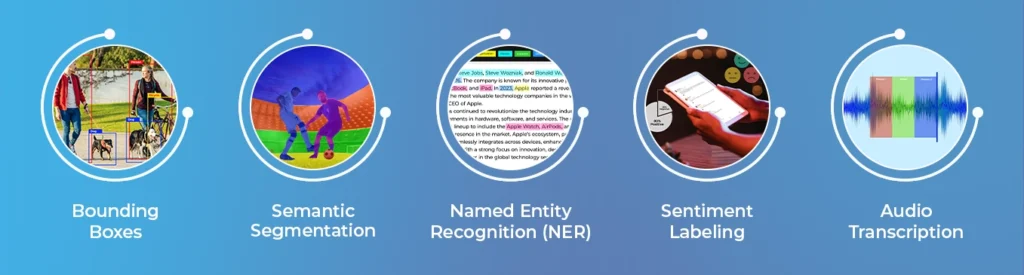
Common annotation tasks include:
- Bounding boxes: Drawing rectangles around objects in images
- Semantic segmentation: Labeling every pixel in an image by category
- Named entity recognition (NER): Identifying and classifying entities in text
- Sentiment labeling: Categorizing text by emotional tone
- Audio transcription: Converting spoken language into text
The quality of your annotations directly impacts model accuracy, bias, and overall performance. Poorly labeled data leads to unreliable predictions, while consistent, high-quality annotations accelerate model training and deployment.
Understanding In-House Data Annotation
What Is In-House Annotation?
In-house annotation refers to labeling work performed by employees or contractors managed internally within your organization. This includes dedicated annotation teams, subject matter experts, or even machine learning engineers who handle labeling as part of their workflow.
How In-House Annotation Works
Building an internal annotation team typically involves:
- Hiring annotators: Recruiting individuals with relevant domain knowledge or training them from scratch
- Onboarding and training: Teaching annotation guidelines, tool usage, and quality standards
- Workflow management: Assigning tasks, tracking progress, and maintaining consistency
- Quality assurance (QA): Reviewing labeled data to ensure accuracy and inter-annotator agreement
- Tool selection: Choosing or building annotation platforms that fit your needs
While this approach requires upfront investment, it gives you direct oversight of every stage of the annotation process.
Pros of In-House Annotation
Full control over data: Sensitive information never leaves your organization, reducing the risk of data breaches or misuse.
Easier communication: Your ML team can collaborate directly with annotators, enabling faster feedback loops and clearer instructions.
Better domain understanding: Annotators familiar with your industry—whether healthcare, finance, or legal—can apply specialized knowledge that improves labeling accuracy.
Stronger data security: You maintain complete control over access permissions, storage, and compliance with regulations like GDPR or HIPAA.
Custom workflows: You can design annotation processes tailored to your specific needs without relying on a vendor’s structure.
Faster iteration for small datasets: When working with limited data, in-house teams can quickly pivot based on model performance feedback.
Cons of In-House Annotation
High operational costs: Salaries, benefits, infrastructure, annotation tools, and management overhead add up quickly—often exceeding $7,000 per annotator per month.
Long hiring and onboarding time: Recruiting qualified annotators and training them to meet quality standards can take weeks or even months.
Scalability challenges: Expanding your team to handle larger datasets requires significant time and resources, making it difficult to meet sudden demand spikes.
Management overhead: Coordinating annotators, maintaining quality, and tracking progress requires dedicated project management.
Risk of inconsistency and burnout: Repetitive annotation work can lead to fatigue, reducing accuracy and increasing turnover.
Limited flexibility during peak demand: If your project suddenly scales up, hiring and training new annotators takes time you may not have.
Understanding Outsourced Data Annotation
What Does It Mean to Outsource Data Annotation?
When you outsource data annotation, you hire a third-party provider to handle the entire labeling process. These vendors manage the workforce, tools, quality assurance, and delivery, allowing you to focus on model development and deployment.
How Outsourcing Typically Works
The outsourcing process generally follows these steps:
- Data transfer: You provide datasets to the vendor through secure channels
- Project guidelines: You share annotation instructions, taxonomies, and quality benchmarks
- Labeling: The vendor’s annotators label your data according to your specifications
- Multi-layer QA: Quality checks ensure consistency and accuracy before delivery
- Final delivery: Annotated data is returned in your preferred format
Most providers offer flexible engagement models, from one-time projects to ongoing partnerships.
Pros of Outsourcing Data Annotation
Lower operational costs: Outsourcing eliminates the need for salaries, benefits, infrastructure, and tool licenses. Pricing is typically variable and scales with your project size.
Access to trained annotators: Reputable vendors maintain pools of experienced annotators who have already been vetted and trained.
Rapid scalability: Need to label 10,000 images this week and 100,000 next month? Outsourcing providers can quickly adjust workforce size to meet your needs.
Faster turnaround times: With dedicated teams working around the clock, you can meet tight deadlines without internal resource strain.
Mature QA processes: Established providers have multi-stage quality checks in place, including inter-annotator agreement metrics and validation workflows.
No recruitment or HR overhead: The vendor handles hiring, training, performance management, and attrition—freeing up your internal team.
Ideal for large datasets: Outsourcing is particularly effective when you need to label massive volumes of data consistently and efficiently.
Easy pilot projects: Test a vendor’s capabilities with a small project before committing to a larger engagement.
When you outsource data annotation, you gain access to scalable, cost-effective labeling without the complexity of building an internal team.
Cons of Outsourcing Data Annotation
Less direct control: You rely on the vendor’s processes and timelines, which may not align perfectly with your internal workflows.
Potential communication gaps: Working with external teams—especially across time zones—can slow down feedback loops and clarification requests.
Data privacy concerns: Sharing sensitive or proprietary data with a third party introduces security risks, especially if the vendor lacks robust compliance measures.
Vendor dependency: Relying on a single provider for critical labeling work can create bottlenecks if they face capacity issues or quality problems.
Quality varies by provider: Not all vendors deliver the same level of accuracy or consistency, making thorough vetting essential.
Time zone differences: If your vendor operates in a different region, real-time collaboration may be challenging.
In-House vs Outsourced Data Annotation: Head-to-Head Comparison
| Factor | In-House Annotation | Outsourced Data Annotation |
| Cost | High fixed cost | Variable & scalable |
| Scalability | Limited | High |
| Speed | Moderate | Fast |
| Data security | High | Depends on vendor |
| Quality control | Direct | Process-driven |
| Flexibility | Low | High |
| Infrastructure | Required | Provided |
| Best for | Small, sensitive datasets | Large, recurring datasets |
This comparison highlights the core differences between the two approaches. In-house annotation offers control and security, while outsourcing provides speed and scalability.
Cost Breakdown: In-House vs Outsourcing
In-House Cost Components
Building an internal annotation team involves multiple cost layers:
- Hiring: Recruiting fees, job postings, and interview time
- Training: Onboarding new annotators and teaching guidelines
- Tools: Licenses for annotation platforms and management software
- Hardware: Workstations, monitors, and computing resources
- Management: Project coordinators and QA specialists
- Attrition: Costs associated with turnover and rehiring
For a single annotator, total costs often exceed $7,000 per month when you factor in salaries, benefits, infrastructure, and management overhead.
Outsourcing Cost Components
When you outsource data annotation, pricing is more straightforward:
- Per-label or per-hour pricing: You pay based on the volume of work completed
- Project management: Typically included in the vendor’s fee
- QA: Built into the service offering
- Setup costs: Minimal, often just a discovery call or pilot project
Outsourcing providers like GetAnnotator offer subscription models starting at $499 per month, including a dedicated annotator, project coordinator, and quality assurance—making it significantly more cost-effective at scale.
Outsourcing is usually cheaper for large datasets, while in-house annotation may be viable for small, highly specialized projects where the upfront investment can be justified.
Quality Control: Which Model Delivers Better Accuracy?
Annotation quality depends less on whether the team is in-house or outsourced, and more on the processes in place to ensure consistency.
Key factors that influence quality include:
- Clear guidelines: Detailed instructions reduce ambiguity and improve inter-annotator agreement
- Annotation consistency: Regular calibration sessions keep annotators aligned
- Inter-annotator agreement (IAA): Measuring how often multiple annotators label the same data identically
In-House Quality Control
In-house teams benefit from direct feedback loops. ML engineers can quickly communicate with annotators to clarify edge cases or adjust guidelines based on model performance.
However, maintaining quality requires dedicated QA resources and ongoing training—especially as team members come and go.
Outsourcing Quality Control
Reputable outsourcing providers implement structured QA processes, including:
- Multi-stage review workflows
- Random sampling for accuracy checks
- Validation by senior annotators
Providers like GetAnnotator maintain ~95% accuracy benchmarks and offer real-time quality monitoring through dedicated project coordinators.
The takeaway? Quality isn’t inherently better with one approach—it depends on how rigorously you enforce standards.
Data Security & Compliance Considerations
Data security is a critical concern, especially when working with sensitive information like personally identifiable information (PII), healthcare records, or financial data.
In-House Security Advantages
Keeping data internal minimizes exposure to third parties. You control access permissions, storage locations, and compliance measures, making it easier to meet strict regulatory requirements.
In-house annotation is often preferred—or even required—for industries like healthcare (HIPAA), finance (PCI-DSS), or legal services.
How Outsourcing Vendors Handle Security
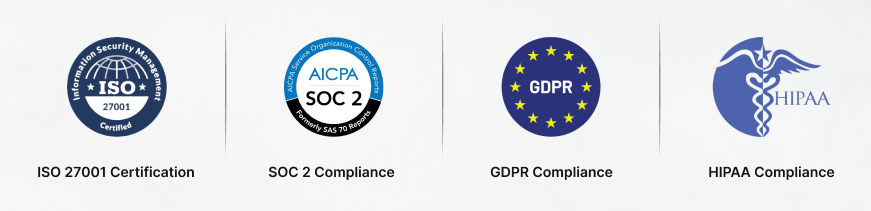
Reputable outsourcing providers take data protection seriously by implementing:
- Non-disclosure agreements (NDAs): Legally binding contracts to protect your data
- ISO 27001 certification: International standard for information security management
- SOC 2 compliance: Audited controls for security, availability, and confidentiality
- GDPR and HIPAA compliance: Adherence to regional and industry-specific regulations
Vendors like GetAnnotator offer privacy-first data handling with secure protocols, ensuring your information remains protected.
When In-House Is Safer
Choose in-house annotation if:
- Your data is highly regulated (e.g., medical imaging, financial records)
- You cannot legally share data with third parties
- Your organization has strict internal compliance policies
When Outsourcing Is Still Compliant
Outsourcing can be secure if:
- The vendor has verifiable certifications (ISO, SOC 2, GDPR, HIPAA)
- You sign robust NDAs and data processing agreements
- The provider uses encrypted data transfer and storage
Scalability & Turnaround Time
Challenges of Scaling Internal Teams
Expanding an in-house annotation team requires:
- Recruiting and hiring new annotators
- Training them on guidelines and tools
- Managing increased coordination and QA workload
This process can take weeks or months, making it difficult to respond quickly to sudden spikes in data volume.
How Outsourcing Enables Rapid Scaling
When you outsource data annotation, providers can quickly allocate additional resources to meet your needs. Benefits include:
- 24/7 workforce: Teams working across time zones ensure continuous progress
- Parallel labeling: Multiple annotators work simultaneously on large datasets
- Faster delivery: Established workflows and trained teams reduce turnaround time
Use-Case Comparison
- Startups: Outsourcing allows startups to label data quickly without the overhead of building a team
- Enterprise: Large organizations often use outsourcing for recurring, high-volume projects while keeping specialized annotation in-house
- Research vs production: Research teams may prefer in-house annotation for iterative experimentation, while production teams benefit from outsourcing’s speed and scale
Which Option Is Better for Your Use Case?
There’s no one-size-fits-all answer. The best choice depends on your project’s scale, budget, timeline, and security requirements.
Choose In-House Annotation If:
- You’re working with highly sensitive or regulated data (e.g., healthcare, finance)
- Your team and dataset are small, and you can justify the upfront investment
- You need specialized domain knowledge that’s difficult to outsource
- Tight feedback loops between ML engineers and annotators are essential
- You prefer complete control over every stage of the annotation process
Choose to Outsource Data Annotation If:
- You’re dealing with large volumes of data that require rapid scaling
- You’re working under tight deadlines and need fast turnaround times
- You have limited internal resources or want to avoid hiring overhead
- Cost efficiency is a priority, and you need predictable pricing
- You require multi-language labeling or access to a global workforce
- You want to focus your internal team on model development rather than annotation
For most businesses, outsourcing offers a faster, more cost-effective path to high-quality labeled data.
Hybrid Model: Best of Both Worlds?
A hybrid approach combines the control of in-house annotation with the scalability of outsourcing.
How the Hybrid Model Works
- In-house teams handle: Guideline creation, edge case review, and quality assurance
- Outsourcing teams handle: High-volume labeling, repetitive tasks, and rapid scaling
Benefits of a Hybrid Approach
- Control + scalability: Maintain oversight while leveraging external capacity
- Cost + quality balance: Reduce expenses without sacrificing accuracy
- Flexibility: Scale up or down based on project demands
This model works well for organizations that need both specialized annotation and large-scale labeling.
Common Mistakes to Avoid
When deciding between in-house and outsourced annotation, watch out for these pitfalls:
- Choosing based on cost only: The cheapest option often compromises quality or speed
- Ignoring QA process: Without structured quality checks, accuracy suffers
- Not testing vendors: Always run a pilot project before committing to a long-term partnership
- Weak annotation guidelines: Vague instructions lead to inconsistent labeling
- Underestimating management effort: In-house annotation requires significant coordination
- No pilot project: Jumping into a large contract without testing workflows increases risk
How to Choose the Right Outsourcing Partner
If you decide to outsource data annotation, selecting the right provider is critical.
What to Look For
- Experience: Does the vendor have a proven track record in your industry or data type?
- Tooling: Do they support the annotation platforms you use, or offer their own?
- Security: Are they compliant with relevant standards (ISO, SOC 2, GDPR, HIPAA)?
- Workforce: Do they have access to trained, vetted annotators?
- QA: What quality assurance processes do they use?
- Pricing transparency: Are costs clear and predictable?
Importance of Trial Projects
Run a small pilot project to evaluate:
- Communication responsiveness
- Annotation accuracy
- Turnaround time
- Alignment with your guidelines
Why Get Annotator?
GetAnnotator offers dedicated annotators, project coordinators, and end-to-end management—all within a single subscription. With plans starting at $499/month, you get:
- A dedicated annotator is assigned within 24 hours
- ~95% accuracy benchmarks
- 24/7 quality monitoring
- Support for 180+ languages
- Integration with popular annotation tools
Whether you’re a startup or enterprise, Get Annotator provides the scalability and quality you need to accelerate your AI projects.
The Right Data Strategy Drives Better AI Results
Choosing between in-house and outsourced data annotation isn’t just about cost or speed—it’s about aligning your labeling strategy with your business goals.
In-house annotation works well for small, sensitive datasets where control and domain expertise are critical. Outsourcing, on the other hand, offers scalability, cost efficiency, and faster turnaround times for large, recurring projects.
For many organizations, a hybrid approach combines the best of both worlds, allowing you to maintain oversight while leveraging external capacity.
No matter which path you choose, the key is to prioritize quality, security, and alignment with your AI objectives. The better your annotation process, the stronger your models will perform.
Ready to scale your annotation workflow without the hassle of hiring and managing an internal team? GetAnnotator provides dedicated annotators, end-to-end project management, and 24-hour onboarding—starting at just $499/month.
FAQs
Ans – For most businesses, yes—especially if you’re working with large datasets, tight deadlines, or limited internal resources. Outsourcing offers cost efficiency, rapid scaling, and access to trained annotators without the overhead of hiring and managing an internal team.
Ans – Costs vary by provider and project complexity. Subscription-based models like GetAnnotator start at $499/month, including a dedicated annotator and project coordinator. Traditional per-label or per-hour pricing depends on data type and volume.
Ans – In-house annotation offers greater control over data access and compliance. However, reputable outsourcing providers implement robust security measures like NDAs, ISO 27001 certification, and GDPR/HIPAA compliance, making outsourcing a viable option for many organizations.
Ans – Yes. Many organizations use a hybrid model—keeping specialized or sensitive annotation in-house while outsourcing high-volume labeling. This approach balances control, quality, and scalability.
Ans – Industries with large-scale labeling needs—such as autonomous vehicles, e-commerce, healthcare AI, and natural language processing—benefit significantly from outsourcing. However, any organization that needs to label data efficiently can gain value from outsourcing.
Ans – Choose providers with structured QA processes, including multi-stage review, inter-annotator agreement metrics, and validation by senior annotators. Run a pilot project to test quality before committing to a larger engagement.
 Previous Blog
Related Blogs

June 8, 2026
Why You Should Outsource Document Annotation
The demand for document artificial intelligence is growing rapidly across almost every industry. Organizations are constantly looking for ways to extract valuable insights from the massive volume of unstructured data they generate daily. High-quality annotated documents are essential for training the machine learning models that make this possible. Without accurately labeled data, even the most […]
Read More

June 5, 2026
Keypoint Annotation Outsourcing Guide for AI Teams
Building highly accurate computer vision models requires massive volumes of flawlessly labeled data. Machine learning engineers and data scientists face mounting pressure to deliver complex datasets rapidly. As computer vision applications evolve to recognize intricate movements and spatial relationships, basic labeling techniques fall short. Keypoint annotation has emerged as a critical requirement for modern AI […]
Read More
June 3, 2026
Scaling AI? Why You Should Outsource Text Annotation Services
Training a robust natural language processing (NLP) model requires massive amounts of high-quality data. AI algorithms do not inherently understand human language. They learn through carefully labeled datasets. Accurate text annotation provides the foundational context that allows AI systems to interpret nuances, sentiment, and user intent. As the complexity of AI models grows, so does […]
Read More

May 27, 2026
Building AI? Why You Need Trusted Data Annotation Platforms
The demand for high-quality AI training data is growing rapidly. Organizations are launching increasingly complex machine learning models, and these systems require massive amounts of accurately labeled data. Annotation quality directly impacts how well an AI model performs in the real world. A poorly trained model will make mistakes, cost your business money, and damage […]
Read More