

- The Growing Demand for High-Quality Training Data
- Challenge #1: Poor Data Quality and Inconsistent Labels
- Challenge #2: Annotation Bottlenecks Slowing Model Development
- Challenge #3: Scaling Annotation for Large Datasets
- Challenge #4: High Cost of Annotation Operations
- Challenge #5: Lack of Domain Expertise
- Challenge #6: Data Security and Privacy Concerns
- How These Challenges Impact AI Model Performance
- What AI Teams Can Do to Reduce Annotation Bottlenecks
- Turning Annotation Challenges Into Competitive Advantage
6 Data Annotation Challenges Stalling Your AI Projects
Building a high-performing artificial intelligence model is a lot like building a high-performance engine. You can have the most sophisticated design and the best engineers, but if you pour low-quality fuel into the tank, the engine won’t run. In the world of AI and machine learning (ML), that fuel is labeled data.
Data annotation—the process of labeling data so machines can understand it—is the foundation of supervised learning. On paper, it sounds straightforward. You take an image, draw a box around a car, and tell the computer, “This is a car.” But in practice, data annotation is often the most complex, expensive, and time-consuming part of the AI lifecycle.
Because ML models are only as good as the data they are fed, getting this step wrong can derail an entire project. Many teams find themselves unprepared for the specific data annotation challenges that arise as they move from proof-of-concept to production. This article explores the most common hurdles AI teams face today and the annotation bottlenecks that threaten to slow down innovation.
The Growing Demand for High-Quality Training Data
The appetite for AI solutions has exploded across every industry. From Large Language Models (LLMs) that power customer service chatbots to computer vision systems used in autonomous driving and medical diagnostics, the scope of what AI can do is expanding rapidly.
As these models become more sophisticated, their hunger for data grows. They don’t just need more data; they need significantly better data. A basic object detection model might work with average-quality images, but a system designed to detect early-stage cancer in radiology scans requires impeccable precision.
This surge in demand puts immense pressure on data pipelines. Teams are scrambling to source, clean, and label massive datasets to keep up with development cycles. It is here, in the rush to feed the algorithms, that the cracks begin to show and the challenges truly begin.
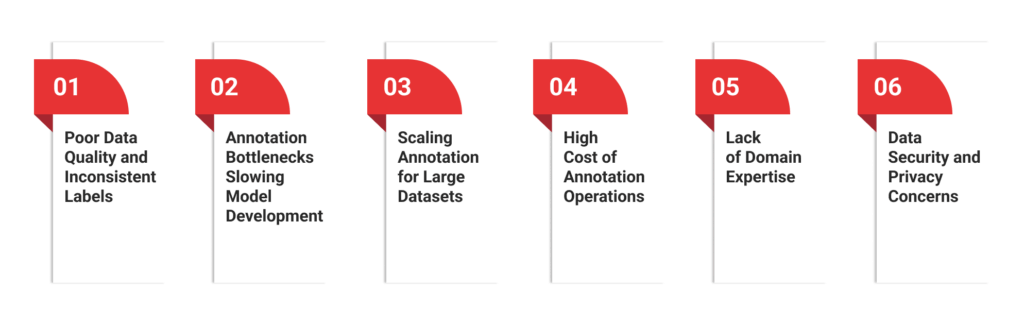
Challenge #1: Poor Data Quality and Inconsistent Labels
One of the most pervasive data annotation challenges is maintaining consistency. Data quality isn’t just about resolution or file formats; it is about the subjective nature of human interpretation.
Consider a dataset of street images. If Annotator A labels a minivan as a “car,” but Annotator B labels a similar vehicle as a “truck,” the dataset becomes noisy. The model receives conflicting instructions on what constitutes a car versus a truck.
This inconsistency wreaks havoc on model accuracy. When the ground truth is muddy, the model struggles to find reliable patterns. The impact is often financial and operational: teams burn budget and time retraining models, only to realize the issue lies in the raw labels, not the algorithm. These inconsistencies usually stem from unclear guidelines, a lack of rigorous Quality Assurance (QA) processes, or rushed timelines that force annotators to prioritize speed over precision.
Challenge #2: Annotation Bottlenecks Slowing Model Development
Speed is critical in AI development, yet annotation bottlenecks frequently bring progress to a grinding halt. An annotation bottleneck occurs when the labeling team cannot keep pace with the data science team’s needs.
Manual labeling is inherently labor-intensive. While engineers can spin up new GPU clusters in minutes, scaling a human workforce takes time. Consequently, highly paid data scientists often find themselves waiting idly for the labeled datasets required to train or validate their next model iteration.
This lag affects everything from experiment cycles to time-to-market. If a competitor can iterate on their model weekly while you are stuck waiting a month for labeled data, you lose your competitive edge. These bottlenecks are often exacerbated by complex data types. Labeling a simple text string is fast; outlining tumors in 3D medical imagery or translating nuances in multilingual audio requires significantly more time and cognitive load.
Challenge #3: Scaling Annotation for Large Datasets
Managing a dataset of 5,000 images is a manageable task for a small internal team. Managing a dataset of 5 million images is an entirely different beast. Scaling brings a host of logistical nightmares that many teams fail to anticipate.
As you move from thousands to millions of data points, you need a larger workforce. Managing a team of five annotators is vastly different from managing a crowd of 500. Maintaining consistency across such a large group becomes exponentially harder. The communication loop regarding edge cases—weird data that doesn’t fit the rules—becomes slow and broken.
This creates a painful trade-off between speed and quality. To move faster, you add more people, but adding more people often dilutes quality. Figuring out how to scale operations without sacrificing the integrity of the data is one of the biggest data annotation challenges enterprise teams face.
Challenge #4: High Cost of Annotation Operations
Annotation is frequently the most underestimated line item in an AI project budget. The costs go far beyond the hourly rate of the labelers.
First, there is the cost of the tooling and platforms required to manage the workflow. Then there is the cost of management and Quality Control (QC)—someone needs to review the work. But the hidden costs are the real budget killers. If a dataset is labeled poorly and needs to be redone, the cost doubles. If a model fails in production because of bad data and requires retraining, the operational costs skyrocket.
Many organizations view annotation as a low-skill, low-cost commodity, only to find that “cheap” annotation becomes incredibly expensive when rework and delays are factored in.
Challenge #5: Lack of Domain Expertise
Not all data can be labeled by a generalist. While anyone can identify a stop sign in an image, very few people can identify a specific clause in a complex legal contract or spot a fracture in a CT scan.
This lack of domain expertise creates a severe annotation bottleneck for specialized industries like healthcare, finance, legal, and engineering. You cannot outsource this work to a general crowdsourcing platform. You need experts—doctors, lawyers, engineers—who are expensive and have very limited time.
If you rely on non-experts for specialized tasks, you risk introducing bias or fundamentally incorrect labels into your system. For example, a non-medical annotator might miss a subtle pathology that a radiologist would catch immediately. Training a model on that flawed data could have serious, real-world consequences.
Challenge #6: Data Security and Privacy Concerns
In the age of GDPR, CCPA, and HIPAA, data security is paramount. AI teams in sectors like finance and healthcare often work with highly sensitive Personal Identifiable Information (PII).
Handing this data over to external annotation teams introduces significant risk. Data leaks, unauthorized access, or non-compliance with data residency laws can lead to massive fines and reputational damage.
Teams must implement strict protocols. This might mean redacting sensitive information before it hits the annotation platform, using air-gapped systems, or requiring annotators to work in secure, monitored physical locations. These necessary security measures add friction to the workflow, slowing down the process and complicating logistics.
How These Challenges Impact AI Model Performance
The consequences of these challenges are direct and measurable. When labels are poor, predictions are poor. A self-driving car that cannot reliably distinguish between a pedestrian and a lamppost because of inconsistent labeling is a safety hazard.
Beyond accuracy, annotation bottlenecks delay deployment. In fast-moving markets, a three-month delay can mean missing the window of opportunity entirely. Furthermore, cost overruns due to rework can drain the ROI of an AI initiative, causing stakeholders to lose confidence in the project. Ultimately, the quality of the annotation process dictates the ceiling of the model’s performance.
What AI Teams Can Do to Reduce Annotation Bottlenecks
While the challenges are real, they are solvable. The key is to treat data annotation as a core engineering discipline rather than an administrative side task.
- Establish a “Gold Standard”: Create a robust set of guidelines and a small “perfect” dataset that all annotators are tested against.
- Invest in QA: Implement automated checks and human review cycles to catch errors early.
- Combine Humans and AI: Use model-assisted labeling (where an AI takes a first pass and a human reviews it) to speed up the process.
- Prioritize Communication: Create a tight feedback loop between the data scientists and the annotation team to resolve edge cases quickly.
By formalizing the process, teams can turn a chaotic workflow into a predictable pipeline.
Turning Annotation Challenges Into Competitive Advantage
The road to building great AI is paved with labeled data. The teams that struggle are often those that view data annotation challenges as a nuisance to be ignored. Conversely, the teams that succeed are those that recognize annotation as a strategic asset.
By acknowledging the difficulties of scaling, quality control, and domain expertise, you can build a workflow that minimizes annotation bottlenecks. In the long run, the ability to generate high-quality data faster than the competition isn’t just an operational detail—it is a massive competitive advantage.
 Previous Blog
Related Blogs

June 8, 2026
Why You Should Outsource Document Annotation
The demand for document artificial intelligence is growing rapidly across almost every industry. Organizations are constantly looking for ways to extract valuable insights from the massive volume of unstructured data they generate daily. High-quality annotated documents are essential for training the machine learning models that make this possible. Without accurately labeled data, even the most […]
Read More

June 5, 2026
Keypoint Annotation Outsourcing Guide for AI Teams
Building highly accurate computer vision models requires massive volumes of flawlessly labeled data. Machine learning engineers and data scientists face mounting pressure to deliver complex datasets rapidly. As computer vision applications evolve to recognize intricate movements and spatial relationships, basic labeling techniques fall short. Keypoint annotation has emerged as a critical requirement for modern AI […]
Read More

June 3, 2026
Scaling AI? Why You Should Outsource Text Annotation Services
Training a robust natural language processing (NLP) model requires massive amounts of high-quality data. AI algorithms do not inherently understand human language. They learn through carefully labeled datasets. Accurate text annotation provides the foundational context that allows AI systems to interpret nuances, sentiment, and user intent. As the complexity of AI models grows, so does […]
Read More

May 27, 2026
Building AI? Why You Need Trusted Data Annotation Platforms
The demand for high-quality AI training data is growing rapidly. Organizations are launching increasingly complex machine learning models, and these systems require massive amounts of accurately labeled data. Annotation quality directly impacts how well an AI model performs in the real world. A poorly trained model will make mistakes, cost your business money, and damage […]
Read More