
- What is Data Annotation for the Agriculture Industry?
- Why Data Annotation is Important for Modern Agriculture
- Types of Data Annotation Used in Agriculture
- Key Use Cases of Data Annotation in Agriculture Industry
- Common Challenges in Agricultural Data Annotation
- Benefits of High-Quality Data Annotation for Agriculture AI
- Best Practices for Data Annotation in Agriculture Industry
- Why Outsource Data Annotation for Agriculture Projects?
- Industries & Stakeholders Using Agricultural Data Annotation
- Future of AI and Data Annotation in Agriculture
- Conclusion
Data Annotation for Agriculture Industry: Use Cases, Benefits & Best Practices
As the global population surges towards 10 billion by 2050, the pressure on food production systems has never been higher. To meet this demand sustainably, the farming sector is undergoing a digital revolution. At the heart of this transformation is data annotation for the agriculture industry—the critical process that teaches AI-powered farming tools how to “see” and understand the field.
From precision crop monitoring and early disease detection to automated weed control and autonomous farming machinery, artificial intelligence is reshaping how we grow food. However, these sophisticated algorithms are only as good as the data they are fed. Without precise, high-quality labeled data, even the most advanced agricultural robots are effectively blind.
In this comprehensive guide, we will explore the fundamentals of data annotation in agriculture, why it is essential for modern farming, the specific techniques used, and the best practices for building robust AI models that can withstand the unpredictable nature of the outdoors.
What is Data Annotation for the Agriculture Industry?
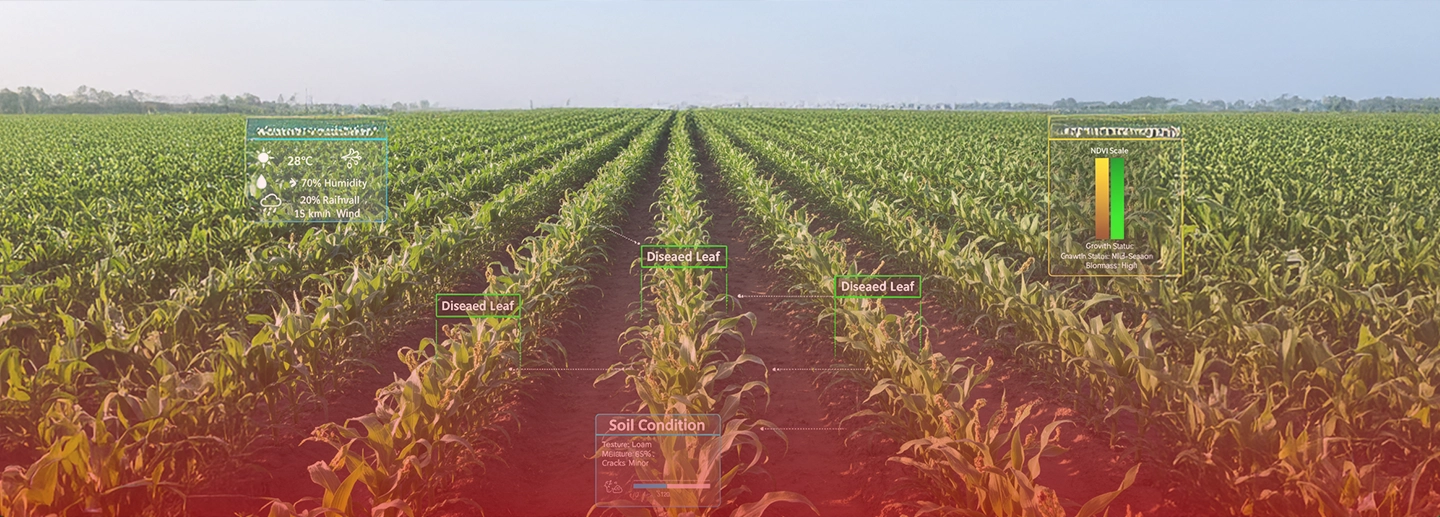
Data annotation in agriculture is the process of labeling raw data—such as images, videos, and sensor readings—so that machine learning (ML) models can recognize patterns and make decisions. Think of it as a teacher guiding a student; the annotator highlights specific objects (like a ripe strawberry or a patch of weeds) within an image, teaching the computer what those objects look like.
This data comes from a variety of sources:
- Drone imagery: High-resolution aerial shots of fields.
- Satellite imagery: Macro-level views for analyzing soil health and crop density.
- Field videos: Ground-level footage from tractors or robots.
- Sensor data: Readings on temperature, moisture, and soil composition.
While generic data annotation might involve labeling cars or pedestrians for self-driving cars, agricultural annotation requires specific domain knowledge. An annotator needs to distinguish between a healthy corn leaf and one suffering from nitrogen deficiency, or differentiate between a crop seedling and an invasive weed. This specificity is what allows ML models to transition from experimental tech to reliable tools in the field.
Why Data Annotation is Important for Modern Agriculture
The stakes in modern agriculture are incredibly high. Farmers are battling a perfect storm of challenges: a growing population demanding more food, a shrinking labor force, the need to reduce chemical usage for environmental safety, and the unpredictability of climate change.
Data annotation serves as the bridge between these challenges and technological solutions.
- Precision Farming: To apply water, fertilizer, and pesticides only where needed, machines must interpret field data with extreme accuracy. Annotated datasets enable this precision, reducing waste and cost.
- Addressing Labor Shortages: With fewer people available to work the fields, autonomous machinery is becoming essential. These robots rely on annotated 3D and 2D data to navigate fields and harvest crops without human intervention.
- Climate Resilience: AI models trained on historical weather and crop performance data can help farmers predict yields and make planting decisions that mitigate climate risks.
Types of Data Annotation Used in Agriculture
Agricultural environments are complex and messy. A single type of annotation is rarely enough. Developers use a mix of techniques to give AI a complete understanding of the farm.
Image Annotation for Agriculture
This is the most common form of labeling. It involves drawing bounding boxes or points on static images.
- Crop Identification: Teaching the AI to recognize specific crop types (e.g., distinguishing wheat from barley).
- Plant Disease Detection: Labeling visual signs of disease, such as rust, blight, or discoloration on leaves.
- Fruit Counting: Annotators place dots or boxes around individual fruits to help yield estimation algorithms.
- Leaf Damage Labeling: Highlighting areas where insects or weather have damaged the plant tissue.
Video Annotation for Agricultural AI
Agriculture doesn’t stand still. Video annotation involves labeling objects across multiple frames of footage.
- Drone Footage Analysis: Tracking the health of a field over time as the drone flies over.
- Crop Growth Tracking: Monitoring how plants change shape and size throughout the season.
- Livestock Monitoring: Tracking the movement and behavior of cattle or sheep to detect illness or estrus.
Semantic Segmentation & Polygon Annotation
For tasks requiring pixel-perfect accuracy, simple boxes aren’t enough. Semantic segmentation involves coloring every pixel of an image that belongs to a specific class.
- Weed vs. Crop Separation: This is crucial for robotic weeders. The AI needs to know exactly where the crop leaf ends and the weed begins to spray herbicide on the weed only.
- Soil vs. Plant Region Labeling: Differentiating between the ground and the vegetation to analyze ground cover percentages.
3D & LiDAR Annotation
As autonomous tractors and harvesters become more common, 3D data is essential for safety and navigation.
- Orchard Navigation: LiDAR point cloud annotation helps robots navigate between tree rows without crashing.
- Autonomous Tractors: detecting obstacles like rocks, humans, or other machinery in a 3D space.
Key Use Cases of Data Annotation in Agriculture Industry
The application of labeled data translates directly into tools that save farmers money and time. Here are the primary use cases driving the industry forward.
Crop Monitoring and Health Analysis
Using multispectral imaging labeled with vegetation indices (like NDVI), AI can detect plant stress before it is visible to the human eye. Annotation helps correlate visual data with specific health issues, such as water stress or nutrient deficiency, allowing for targeted intervention.
Weed Detection and Smart Spraying
This is perhaps the most financially impactful use case. By training models to distinguish weeds from crops via polygon annotation, smart sprayers can target individual weeds. This technology can reduce herbicide usage by up to 90%, significantly lowering costs and environmental impact.
Plant Disease and Pest Detection
Early detection is key to saving a harvest. Annotators label thousands of images of fungal infections, bacterial spots, and insect damage. AI models trained on this data can scan fields via drones and alert farmers to outbreaks while they are still localized, preventing widespread infestation.
Automated Harvesting and Robotics
Harvesting robots need to know three things: Where is the fruit? Is it ripe? How do I grab it without bruising it?
- Fruit Detection: Identifying the fruit amidst leaves and branches.
- Ripeness Classification: Labeling fruit based on color and size stages.
- Robotic Arms: Annotating the best “grasping points” for the robotic arm to ensure a gentle harvest.
Yield Prediction and Farm Analytics
By combining historical yield data, weather patterns, and satellite imagery, AI can forecast harvest quantities. Annotation ensures the satellite data is correctly interpreted (e.g., distinguishing between cloud cover and snow, or urban areas and fields), leading to more accurate financial planning for farmers.
Common Challenges in Agricultural Data Annotation
Labeling data for agriculture is significantly harder than labeling urban environments. The natural world is unstructured and constantly changing.
- Seasonal Changes: A corn field looks completely different in June than it does in September. Models need data from every growth stage.
- Lighting and Shadows: Outdoor lighting is uncontrollable. Shadows from clouds or the angle of the sun can obscure crops.
- Occlusion: In a dense field, leaves overlap. Fruit is often hidden behind branches. Annotators must be skilled at estimating the shape of objects that are partially hidden.
- Similarity: To an untrained eye—and an untrained AI—a young weed can look identical to a young crop sprout. Distinguishing between them requires high-resolution data and expert judgment.
- Volume and Cost: An acre of land generates terabytes of data. Labeling this volume is time-consuming and expensive.
Benefits of High-Quality Data Annotation for Agriculture AI
Investing in high-quality annotation is an investment in the reliability of the final product.
- Improved Model Accuracy: Precise labels lead to precise predictions. There is no shortcut around this.
- Lower False Positives: In weeding, a false positive means killing a crop. High-quality data prevents this.
- Better Decision-Making: When farmers trust the data, they make bolder, more efficient decisions regarding irrigation and harvesting.
- Reduced Chemical Usage: Accurate targeting means chemicals are only applied where necessary.
- Scalable AI Solutions: A robust dataset allows models to adapt to different fields and regions more easily.
Best Practices for Data Annotation in Agriculture Industry
To overcome the challenges of agricultural data, AgriTech companies should adhere to specific protocols.
Choose the Right Annotation Method
Don’t use a sledgehammer to crack a nut, and don’t use a bounding box when you need a scalpel. If you are counting cattle, bounding boxes are fine. If you are training a robot to pick strawberries, you need polygon segmentation to define the exact shape of the berry.
Use Human-in-the-Loop QA
Automated labeling tools exist, but they struggle with the complexity of nature. Always have a “human in the loop” (HITL) for quality assurance. Expert validation ensures that the edge cases—the weirdly shaped potato or the shadowed leaf—are labeled correctly.
Build Crop-Specific Guidelines
Guidelines cannot be generic. Wheat, corn, and rice have different structures and growth patterns. Create specific instruction sets for annotators for each crop type to ensure consistency.
Handle Edge Cases
What happens when a leaf is half-eaten by a bug? Do you label it as a leaf or not? You need clear protocols for damaged leaves, occluded fruit, and blurry images. Usually, it is better to discard bad data than to label it poorly.
Maintain Annotation Consistency
If one annotator labels the stem of the plant and another excludes it, the model will be confused. Regular audits and standardized training for annotation teams are mandatory to maintain consistency across large datasets.
Why Outsource Data Annotation for Agriculture Projects?
Given the volume of data and the need for expertise, many AgriTech firms choose to outsource their data annotation rather than building internal teams.
- Scalability: Outsourcing partners can ramp up the workforce during harvest season and scale down during winter.
- Domain Expertise: Specialized firms often have annotators who are specifically trained in agricultural datasets.
- Cost Efficiency: It is generally more cost-effective to use an external team than to recruit, hire, and manage hundreds of temporary in-house staff.
- Data Security: Reputable providers have strict security protocols to protect proprietary farm data.
- Faster Turnaround: With dedicated teams working around the clock, models can be trained and deployed faster.
Industries & Stakeholders Using Agricultural Data Annotation
The ecosystem of companies relying on this data is vast:
- AgriTech Startups: Developing niche robots for specific crops (e.g., tomato pickers).
- Precision Farming Companies: Large enterprises offering full-stack farm management software.
- Drone Analytics Providers: Companies selling “fields-as-a-service” insights.
- Smart Irrigation Firms: Using soil and plant data to automate water usage.
- Autonomous Tractor Companies: Manufacturers like John Deere and Case IH.
- Research Institutions: Universities studying climate change impacts on crop resilience.
Future of AI and Data Annotation in Agriculture
The future of farming is digital. We are moving toward smart farming ecosystems where every plant is monitored individually. Autonomous farms where robots handle the entire cycle from planting to harvest are no longer science fiction—they are in development.
As we look toward climate-resilient crops and digital twins of entire agricultural systems, the need for data will only grow. The complexity of these models will require even more granular, 3D, and spectral data annotation.
Conclusion
Data annotation for the agriculture industry is not just a technical requirement; it is a cornerstone of sustainable food production. By converting raw chaos of the natural world into structured insights, we enable machines to help us farm smarter, cleaner, and more efficiently.
Whether you are building a robotic harvester or a predictive yield model, your success depends on the quality of your training data. Don’t let poor data bottleneck your innovation.
If you are ready to scale your AgriTech solution, now is the time to prioritize your data strategy. Partner with experts to annotate your agricultural data and start your AI project on the path to success.
 Previous Blog
Related Blogs

June 8, 2026
Why You Should Outsource Document Annotation
The demand for document artificial intelligence is growing rapidly across almost every industry. Organizations are constantly looking for ways to extract valuable insights from the massive volume of unstructured data they generate daily. High-quality annotated documents are essential for training the machine learning models that make this possible. Without accurately labeled data, even the most […]
Read More

June 5, 2026
Keypoint Annotation Outsourcing Guide for AI Teams
Building highly accurate computer vision models requires massive volumes of flawlessly labeled data. Machine learning engineers and data scientists face mounting pressure to deliver complex datasets rapidly. As computer vision applications evolve to recognize intricate movements and spatial relationships, basic labeling techniques fall short. Keypoint annotation has emerged as a critical requirement for modern AI […]
Read More

June 3, 2026
Scaling AI? Why You Should Outsource Text Annotation Services
Training a robust natural language processing (NLP) model requires massive amounts of high-quality data. AI algorithms do not inherently understand human language. They learn through carefully labeled datasets. Accurate text annotation provides the foundational context that allows AI systems to interpret nuances, sentiment, and user intent. As the complexity of AI models grows, so does […]
Read More

May 27, 2026
Building AI? Why You Need Trusted Data Annotation Platforms
The demand for high-quality AI training data is growing rapidly. Organizations are launching increasingly complex machine learning models, and these systems require massive amounts of accurately labeled data. Annotation quality directly impacts how well an AI model performs in the real world. A poorly trained model will make mistakes, cost your business money, and damage […]
Read More