

- The Growing Need for Remote Data Labeling
- What is Remote Data Labeling?
- Benefits of Using Remote Data Labeling Services
- Challenges in Remote Data Labeling (and How to Overcome Them)
- Key Features to Look for in a Remote Data Labeling Provider
- Use Cases: Industries Benefiting from Remote Data Labeling
- The Future of AI Depends on Efficient Data Ops
What Are Remote Data Labeling Services? Benefits, Challenges & Best Practices
The artificial intelligence boom isn’t slowing down. As AI models become more sophisticated, the hunger for high-quality, accurately labeled data grows exponentially. However, for many machine learning teams, the bottleneck isn’t the algorithm—it’s the data.
Building an in-house annotation team is expensive, slow, and operationally heavy. On the flip side, relying on unvetted crowdsourcing can lead to poor quality control and security risks. This is where remote data labeling services step in as the critical middle ground, offering the scalability of the crowd with the precision of a dedicated team.
In this guide, we will explore why remote data labeling is becoming the standard for top-tier AI development, how it works, and how to choose a provider that aligns with your security and quality needs.
The Growing Need for Remote Data Labeling
The old adage “garbage in, garbage out” has never been truer than in the age of generative AI and computer vision. An autonomous vehicle algorithm trained on poorly bounding-boxed pedestrians will fail. A medical diagnostic tool trained on mislabeled X-rays is dangerous.
As the demand for training data skyrockets, companies are realizing that data labeling is a specialized skill, not just a side task for interns.
Why in-house teams are struggling
Maintaining an internal team requires recruitment, onboarding, HR management, and equipment costs. If your data volume fluctuates—which it almost always does—you are left paying for idle hands during quiet periods or scrambling to hire during crunches.
Why pure crowdsourcing falls short
While cheap, crowdsourcing platforms often lack accountability. You might have ten different people labeling the same dataset with ten different interpretations of your guidelines. This inconsistency introduces “noise” into your model, lowering its predictive accuracy.
Remote data labeling services bridge this gap by offering managed, professional teams that work remotely but function as an extension of your internal workforce.
What is Remote Data Labeling?
Remote data labeling involves outsourcing the tagging, annotating, and classification of data (images, text, audio, and video) to a third-party workforce that operates off-site.
Unlike traditional outsourcing, modern remote labeling services—like GetAnnotator—move away from the gig-economy model. Instead of anonymous tasks grabbed by random users, you are assigned dedicated annotators. These professionals:
- Understand your specific domain (e.g., medical imaging, geospatial data, or legal text).
- Follow your specific workflows and guidelines.
- Integrate with your tools, whether you use CVAT, Labelbox, or a proprietary platform.
It is essentially “Staff Augmentation” for data operations. You get the team without the overhead.
Benefits of Using Remote Data Labeling Services

Switching to a managed remote model offers strategic advantages that go beyond just saving a few dollars.
1. Cost-Effectiveness without Quality Compromise
Hiring an internal annotator involves salaries, benefits, office space, and hardware. Remote services operate on a subscription or hourly model, often reducing costs by up to 50% compared to traditional hiring. You pay for the work done, not the downtime.
2. Infinite Scalability
In the early stages of model training, you might need two annotators. Before a major product launch, you might need fifty. Remote services allow you to scale up or down instantly. With platforms like GetAnnotator, you can add more “seats” to your subscription and have new team members ready in 24 hours, avoiding the weeks-long hiring cycle of HR departments.
3. Access to Global Expertise
Remote labeling removes geographical barriers. If you need annotators who are fluent in specific dialects for NLP (Natural Language Processing) projects, or experts with a background in radiology for medical AI, remote services can source this talent from a global pool rather than being limited to your local zip code.
4. Speed to Deployment
Time-to-market is critical in the AI race. Remote services come with pre-vetted talent. This means you skip the sourcing, interviewing, and background checks. You simply define the project, and the team starts working.
Challenges in Remote Data Labeling (and How to Overcome Them)
While the benefits are clear, remote work comes with inherent challenges that must be managed.
Data Security and Privacy
The Challenge: sending sensitive data (like PII or proprietary IP) to remote workers can feel risky.
The Solution: Choose providers that are GDPR and ISO 27001 compliant. Look for services that offer secure workspaces where data cannot be downloaded locally by the annotator.
Quality Control
The Challenge: ensuring a remote worker in a different time zone understands the nuances of “occluded objects” in a video frame.
The Solution: Opt for managed services that include a Project Coordinator. This person acts as your single point of contact, conducting QA checks and ensuring the annotators are adhering to your guidelines before the data ever reaches you.
Communication Gaps
The Challenge: feedback loops can be slow if you rely on email.
The Solution: Use platforms that offer real-time dashboard access and direct chat features. Being able to clarify an instruction instantly can save days of rework.
Key Features to Look for in a Remote Data Labeling Provider
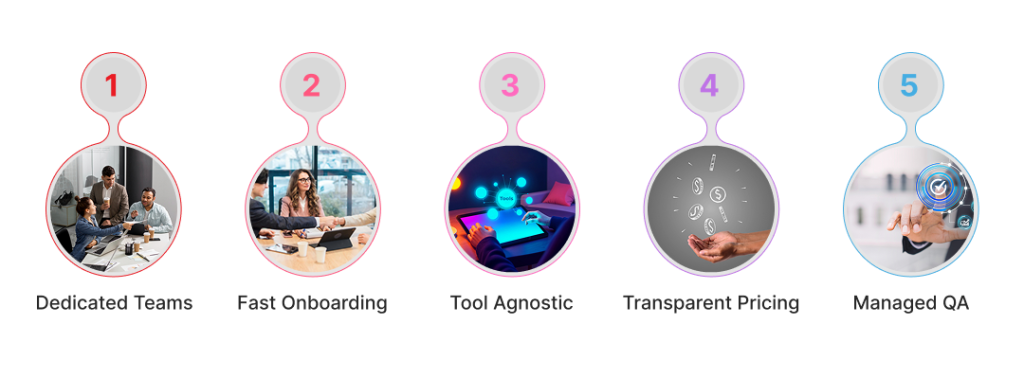
Not all labeling services are created equal. When evaluating a partner, use this checklist to ensure they can meet enterprise standards.
- Dedicated Teams: Do you get the same annotators every day, or is it a rotating door of freelancers? Consistency helps annotators learn your specific edge cases over time.
- Fast Onboarding: Can they start in 24 hours, or does it take weeks to set up?
- Tool Agnostic: Do they force you to use their labeling tool, or will their annotators work within your existing stack (e.g., AWS SageMaker, Roboflow, SuperAnnotate)?
- Transparent Pricing: Are there hidden management fees, or is it a flat monthly subscription?
- Managed QA: Is there a project manager included in the cost to oversee quality?
Use Cases: Industries Benefiting from Remote Data Labeling
Autonomous Vehicles
LIDAR and video annotation are incredibly time-consuming. Remote teams draw millions of bounding boxes and polygon points to help cars recognize lanes, pedestrians, and traffic signs.
Healthcare & MedTech
Medical annotation requires domain expertise. Remote services can source annotators with medical backgrounds to label tumors in MRI scans or classify medical records, strictly adhering to HIPAA and privacy standards.
E-Commerce & Retail
From categorizing product catalogs to training visual search engines (e.g., “find me shoes like this”), remote teams handle the vast volume of inventory data required for personalized shopping experiences.
Agriculture (AgriTech)
Drones capture terabytes of footage of crops. Remote annotators label weeds, pests, and crop health indicators to help automate farming processes.
The Future of AI Depends on Efficient Data Ops
As AI models move from experimental phases to real-world deployment, the infrastructure supporting them must mature. The “do it yourself” era of data labeling is fading. The future belongs to agile, scalable, and professional remote teams that integrate seamlessly with development cycles.
By partnering with a dedicated remote data labeling service, you aren’t just outsourcing a task; you are unlocking the ability to iterate faster, reduce burn rate, and focus your internal core team on what they do best: building the models of tomorrow.
If you are looking to scale your annotation efforts without the headache of hiring, consider a managed subscription model. It might just be the competitive edge your AI project needs.
 Previous Blog

Related Blogs

June 8, 2026
Why You Should Outsource Document Annotation
The demand for document artificial intelligence is growing rapidly across almost every industry. Organizations are constantly looking for ways to extract valuable insights from the massive volume of unstructured data they generate daily. High-quality annotated documents are essential for training the machine learning models that make this possible. Without accurately labeled data, even the most […]
Read More

June 5, 2026
Keypoint Annotation Outsourcing Guide for AI Teams
Building highly accurate computer vision models requires massive volumes of flawlessly labeled data. Machine learning engineers and data scientists face mounting pressure to deliver complex datasets rapidly. As computer vision applications evolve to recognize intricate movements and spatial relationships, basic labeling techniques fall short. Keypoint annotation has emerged as a critical requirement for modern AI […]
Read More

June 3, 2026
Scaling AI? Why You Should Outsource Text Annotation Services
Training a robust natural language processing (NLP) model requires massive amounts of high-quality data. AI algorithms do not inherently understand human language. They learn through carefully labeled datasets. Accurate text annotation provides the foundational context that allows AI systems to interpret nuances, sentiment, and user intent. As the complexity of AI models grows, so does […]
Read More

May 27, 2026
Building AI? Why You Need Trusted Data Annotation Platforms
The demand for high-quality AI training data is growing rapidly. Organizations are launching increasingly complex machine learning models, and these systems require massive amounts of accurately labeled data. Annotation quality directly impacts how well an AI model performs in the real world. A poorly trained model will make mistakes, cost your business money, and damage […]
Read More